Glasgow's Tree Surgeons Since 2005
Tree Cabling & Bracing Glasgow | Glasgow Trees
Cabling, bracing and Cobra support systems for storm-damaged, splitting or leaning trees across Glasgow – NPTC-certified arborists, BS3998-compliant installations and a free structural assessment before any work is booked.
A tree with two main stems growing from the same point, a crack that's opened up the trunk after a winter gale, or a heavy limb that's started to lean over a path doesn't automatically mean felling. In a lot of cases a cabling or bracing system, fitted correctly and checked afterwards, gives a mature tree years of safe life instead of ending as a stump and a bill for grinding it out. This page covers how that kind of structural weakness gets assessed and which support system actually suits it, rather than treating every tree the same way.
If the assessment finds a tree is too far gone for a support system to help - decay through the union, damage too advanced - that's the point where tree removal gets quoted instead, as a separate job rather than an automatic upsell. Where what's actually needed is a formal written condition report for a mortgage, insurance claim or planning application, rather than the shorter assessment that comes free with a support-system quote, our tree inspection service covers that on its own. Everything below is specific to fitting cable or brace hardware in the canopy, not a general case for tree surgery.
The species growing in a garden matters as much as the defect itself. Multi-stemmed sycamore, lime and beech are common in Glasgow's older gardens and street plantings, and it's exactly that kind of co-dominant growth - two or more stems competing for the same space, with bark trapped in the join rather than a solid wood graft - that tends to fail first once a gale gets into the canopy, because there's no natural union holding the stems together, only compressed bark that can't take a load. A birch or rowan with a single clean leader rarely needs a support system fitted; it's the multi-stemmed specimens, and the older trees that were topped or reduced hard at some point in the past and have since thrown up a crowded, poorly attached new crown, that tend to get flagged during a routine assessment even before any storm has done visible damage. Knowing which of those situations is in front of us before a ladder or rope goes anywhere near the tree is most of what a proper assessment actually is.
Timing also matters more than most tree owners expect. A union that's been under stress all summer with a full crown of leaves catching wind is carrying a very different load to the same union in winter once the leaves are down, and a defect that looks stable in July can open up further after the first real autumn or winter storm. That's one reason the free assessment doesn't just look at the crack or split in isolation - it takes account of the tree's position, how exposed the site is, and what's likely to change over the coming season, rather than only describing what's visible on the day of the visit.
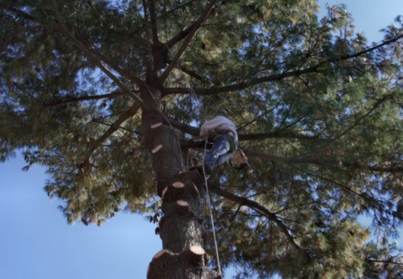
On site, a typical assessment starts with a walk around the tree at ground level, not straight up into the crown. Bark that's cracked or lifted at the base of a stem, fungal brackets at the root flare, or a hollow sound when the trunk's tapped near a union are all checked before any climbing gear goes on, since they change what a support system further up can actually achieve. Only once that ground-level check is done does the climb happen, using rope and harness rather than spikes, which would only add fresh wounds to a tree that's already under stress.
Left unaddressed, this kind of defect doesn't usually stay the same size. A weak union that's held for years can widen after one bad gust, and a hairline split that was barely visible in an assessment two winters ago can become the reason a limb comes down over a fence or a car the next time the wind gets into it. That's not a reason to panic about every crack or narrow fork - plenty of trees carry minor included bark for decades without incident - but it is why a defect that's been mentioned in passing, by a neighbour, a previous tradesperson, or a gut feeling that a stem "doesn't look right", is worth having looked at properly rather than left for another season on the assumption it will keep holding.
It's also worth saying what this page isn't about. Cabling and bracing address a structural weakness in an otherwise viable tree - they're not a treatment for disease, pest damage or root problems, and a tree that's dying back from the base up needs a different conversation regardless of how sound the upper crown looks. Where the actual issue turns out to be root plate movement, fungal decay at ground level, or a health problem rather than a structural one, the assessment will say so plainly rather than proposing a cable or brace that wouldn't address the real cause.
At a Glance
- Free structural assessment within 24 hours
- NPTC-qualified in aerial rescue and rigging, not just general tree work
- Installations to British Standard BS3998, backed by £5 million insurance
Domestic Tree Cabling & Bracing Glasgow:
0141-483-7485 Professional Structural Support Systems for Glasgow Properties
Expert tree cabling and bracing services for domestic properties across Glasgow and Central Scotland. Our NPTC certified arborists provide modern dynamic support systems with 30+ years combined experience, £5 million insurance coverage, and proven results.
Is your valuable mature tree showing signs of structural weakness that could lead to catastrophic failure? Glasgow Trees delivers professional tree cabling and bracing services throughout Glasgow, combining our deep local expertise with cutting-edge dynamic support technology through our partnership with CNJ Tree Services. Our qualified arborists safely install structural support systems that preserve irreplaceable trees whilst protecting your property and family.
Call 0141-483-7485 now for your FREE tree structural assessment within 24 hours.
Why Professional Tree Cabling & Bracing is Essential
Dangerous Signs Your Trees Need Structural Support
Tree structural failures cause devastating property damage and serious injuries throughout Glasgow every year. Heavy branches creating dangerous imbalances, multiple trunks with weak V-shaped unions under 45 degrees, and visible cracks or splits in major limbs represent serious safety hazards requiring immediate professional intervention.
Storm damage frequently creates structural compromises that worsen over time, whilst mature trees with poor early training develop dangerous weight distributions. Trees leaning toward your home, garden structures, or neighbouring properties pose significant liability risks that insurance companies increasingly scrutinise.
Without professional structural support, these weaknesses lead to catastrophic failures during Glasgow’s unpredictable weather, causing expensive property damage and potentially fatal injuries to family members or visitors.
Critical Warning Signs:
- Heavy branches creating visible tree imbalance
- Multiple trunks with narrow V-shaped connections
- Cracks, splits, or bark inclusion in major limbs
- Storm damage creating structural compromises
- Trees leaning toward buildings or public areas
- Poor weight distribution from inadequate early pruning
Consequences of Ignoring Tree Structural Weaknesses
Delaying professional structural support leads to increasingly expensive problems that ultimately cost far more than preventive intervention. Catastrophic branch or trunk failures during storms cause devastating damage to homes, vehicles, and garden structures, whilst creating serious liability issues if debris damages neighbouring properties.
Insurance companies often refuse coverage for preventable tree failures where structural problems were ignored despite obvious warning signs. Complete tree loss becomes inevitable when problems that could have been resolved through professional support systems are left untreated.
The replacement cost of mature trees ranges from £5,000-15,000+ for established specimens, making professional preservation through structural support exceptionally cost-effective compared to removal and replanting.
Expensive Consequences:
✅ Catastrophic property damage during storms
✅ Serious injury risks requiring immediate intervention
✅ Insurance complications from preventable failures
✅ Complete loss of irreplaceable mature specimens
✅ Liability issues affecting neighbouring properties
Why DIY Support Attempts Fail Dangerously
Amateur attempts at tree structural support consistently fail and often make problems worse through improper installation techniques. Incorrect cable placement increases stress concentration rather than reducing it, whilst wrong materials lead to tree girdling and eventual death.
DIY installations lack understanding of tree biomechanics and load distribution, creating systems that fail catastrophically when most needed during severe weather. Working at height without proper training and equipment creates serious safety risks, whilst incorrectly installed systems create legal liability if they fail and cause damage.
Professional installation requires specialist knowledge, proper materials, and expert assessment that only qualified arborists possess.
DIY Failure Risks:
- Improper placement increasing rather than reducing stress
- Wrong materials causing girdling and tree death
- Safety dangers from untrained height work
- Legal liability from incorrectly installed systems
- Complete system failure when protection is most needed
Professional tree structural support: Call 0141-483-7485 for expert assessment.
Our Professional Tree Cabling & Bracing Services
Modern Dynamic Cabling Systems
Our professional dynamic cabling systems use advanced synthetic fabric materials that allow natural tree movement whilst providing crucial structural support. Unlike outdated static steel cables that restrict growth and weaken trees over time, modern dynamic systems actually strengthen trees by allowing controlled flexing that builds structural resilience.
These flexible support systems redistribute weight and stress across the tree structure, preventing weak points from failing under extreme weather conditions. Professional installation preserves tree health whilst delivering long-term structural integrity that static systems cannot match.
Our NPTC certified team assesses each tree’s unique biomechanics to determine optimal cable placement, ensuring maximum effectiveness with minimal visual impact on your garden’s appearance.
Dynamic Cabling Advantages:
- Natural movement strengthening trees over time
- Synthetic materials lasting longer than steel cables
- Minimal visual impact preserving garden aesthetics
- Professional installation preventing tree damage
- Suitable for most domestic tree species and situations
Professional Rigid Bracing Solutions
For trees with severe structural defects requiring maximum support, our rigid steel bracing systems provide uncompromising strength against torsional forces during violent weather. Through-rod braces pass completely through weak unions with secure bolting, whilst dead-end braces thread directly into tree structure for permanent reinforcement.
Rigid bracing becomes essential for trees with significant trunk splits, co-dominant leaders, or major structural compromises that dynamic cabling cannot adequately address. Professional assessment determines when rigid support provides the optimal solution for long-term tree preservation.
Our experienced team combines rigid bracing with complementary treatments including crown reduction and health improvement programs, ensuring comprehensive structural rehabilitation.
Rigid Bracing Applications:
- Severe trunk splits requiring maximum support
- Co-dominant leaders with failure potential
- Major structural defects beyond dynamic cabling scope
- Emergency repairs following storm damage
- Heritage trees requiring permanent reinforcement
Advanced Cobra Dynamic Support Systems
Through our partnership with CNJ Tree Services, Glasgow Trees provides access to cutting-edge Cobra dynamic support technology specifically designed for heritage and veteran tree management. These advanced systems offer shock-absorbing properties that reduce oscillation damage whilst allowing natural tree movement.
Cobra systems feature adjustable components enabling modification as trees mature, making them ideal for long-term management of valuable specimens. Non-invasive installation techniques preserve tree health whilst delivering superior structural support for irreplaceable mature trees.
This specialist technology represents the most advanced tree support systems available, typically reserved for high-value heritage trees and challenging preservation projects.
Cobra System Benefits:
- Advanced shock-absorption technology
- Adjustable systems accommodating tree growth
- Non-invasive installation preserving tree health
- Ideal for heritage and veteran tree preservation
- Specialist technology through CNJ partnership access
Expert structural support for any domestic tree: 0141-483-7485
Professional Assessment & Installation Process
Comprehensive Tree Structural Analysis
Every tree cabling and bracing project begins with our comprehensive FREE structural assessment conducted by NPTC certified arborists with specialist training in tree biomechanics. Professional evaluation identifies potential failure points, assesses load distribution, and determines optimal support system design for your tree’s unique requirements.
Our detailed analysis considers tree species characteristics, wood strength properties, site constraints, and environmental factors affecting long-term system effectiveness. Risk assessment evaluates proximity to buildings, utilities, and public areas, ensuring support systems provide maximum safety benefits.
Written reports document findings and recommendations with clear explanations of proposed solutions, installation methodology, and ongoing maintenance requirements, providing complete transparency throughout the decision-making process.
Professional Assessment Includes:
- Tree biomechanics and load distribution analysis
- Species-specific wood strength evaluation
- Site constraint and environmental factor assessment
- Risk evaluation for property and public safety
- Written report with detailed recommendations
Customised Support System Design
Professional support system design requires expert knowledge of tree biomechanics, material properties, and installation techniques that only qualified arborists possess. Our team creates site-specific solutions optimised for each tree’s unique structural requirements, ensuring maximum effectiveness with minimal environmental impact.
Load calculations determine appropriate cable specifications and brace requirements, whilst installation planning minimises garden disruption during system installation. Integration with existing tree health and pruning programs maximises overall treatment effectiveness.
Quality materials meeting British Standards ensure long-term durability in Scotland’s challenging weather conditions, whilst professional installation techniques preserve tree health throughout the support system lifespan.
Design Considerations:
- Site-specific solutions for unique tree requirements
- Load calculations ensuring appropriate specifications
- Integration with tree health and pruning programs
- Quality materials meeting British Standards compliance
- Professional techniques preserving long-term tree health
Expert Installation Standards
Our professional installation process employs specialist equipment and expert techniques ensuring safe, effective support system installation with minimal tree damage. Professional tree climbing or aerial platform access enables precise hardware placement, whilst careful drilling and installation techniques preserve tree health.
All work complies with British Standards BS3998 for tree work, ensuring professional quality and safety throughout the installation process. Our £5 million public liability insurance provides comprehensive coverage for all operations, giving complete peace of mind during complex structural work.
Complete documentation includes system specifications, installation details, and maintenance requirements for insurance records and property management purposes.
Installation Excellence:
- Specialist equipment ensuring safe height work
- Precise placement minimising tree damage
- BS3998 compliance guaranteeing professional standards
- £5 million insurance covering all operations
- Complete documentation for property records
Professional installation with guaranteed results: Call 0141-483-7485
Tree Cabling & Bracing Investment & Value
Transparent Pricing Structure
Glasgow Trees operates completely transparent pricing for domestic tree cabling and bracing with comprehensive quotations detailing all costs and services included. Professional assessment and detailed quotation are always provided FREE, ensuring you understand exactly what’s required before any work begins.
Typical domestic installations range from £200-800 per tree depending on size, complexity, and support system requirements. Multiple tree packages receive significant discounts, making comprehensive garden tree support highly cost-effective for properties with several mature specimens.
All quotations include materials, expert installation, follow-up inspection, and comprehensive warranties with no hidden costs or surprise charges affecting your budget.
Pricing Transparency Includes:
- FREE professional assessment and detailed quotation
- All materials and installation costs clearly itemised
- Multiple tree discounts for comprehensive projects
- No hidden costs or unexpected additional charges
- Comprehensive warranties on materials and workmanship
Investment Factors Affecting Costs
Several factors influence the final investment required for professional tree structural support, ensuring accurate pricing that reflects the specific work involved. Tree size and height represent primary cost factors, with larger specimens requiring more complex support systems and installation techniques.
Number of support points needed affects material and labour requirements, whilst access difficulties including confined spaces or proximity to buildings may require specialist equipment and additional safety measures. System type selection between dynamic cabling, rigid bracing, or advanced Cobra technology influences overall project costs.
Integration with complementary tree services including crown reduction, health treatments, or pruning provides excellent value through combined service packages.
Cost Influencing Factors:
- Tree size and height: Primary cost determination
- Support system complexity: Number of cables or braces required
- Access challenges: Confined spaces or building proximity
- System technology: Dynamic, rigid, or advanced Cobra systems
- Additional services: Pruning, health treatments, crown reduction
Typical Investment Ranges and Value
Small Garden Trees (Single cable support): £200-350
- Quick installation with minimal garden disruption
- Suitable for fruit trees and ornamental specimens
- Prevents branch failure and extends tree life
- Excellent value for preserving garden aesthetics
Medium Mature Trees (Multiple support points): £400-600
- Comprehensive support for family garden specimens
- Professional assessment and customised design
- Long-term protection for valuable landscape trees
- Popular choice for suburban property enhancement
Large Heritage Trees (Advanced systems): £600-800+
- Specialist equipment and advanced technology required
- Professional preservation of irreplaceable specimens
- Maximum protection for high-value mature trees
- CNJ partnership capabilities for challenging projects
Multiple Tree Packages: 15-25% discount on additional specimens
- Significant savings for comprehensive garden protection
- Single mobilisation reducing overall project costs
- Coordinated approach maximising treatment effectiveness
Long-Term Investment Value and Returns
Professional tree structural support systems deliver exceptional long-term value extending far beyond initial installation costs. Quality systems last 20-40 years with proper maintenance, providing decades of reliable protection at minimal annual cost compared to tree replacement expenses.
Mature tree preservation protects landscape investments worth £5,000-15,000+ per specimen, whilst preventing expensive property damage from structural failures. Insurance benefits from proactive risk management often result in reduced premiums, whilst maintained property values reflect well-preserved mature landscaping.
Environmental benefits from preserving established trees provide immeasurable value through continued air purification, carbon sequestration, and wildlife habitat preservation that young replacement trees cannot match.
Investment Value Benefits:
✅ 20-40 year system lifespan with proper maintenance
✅ Preserve tree investments worth £5,000-15,000+ per specimen
✅ Prevent expensive property damage from structural failures
✅ Insurance benefits through proactive risk management
✅ Environmental value from mature tree preservation
Invest in professional tree preservation: 0141-483-7485
Supporting Glasgow’s Urban Forest & Environmental Leadership
Preserving Glasgow’s Champion Trees and Heritage Specimens
Glasgow’s impressive 15% tree canopy coverage significantly exceeds the UK urban average, supporting over 450 tons of annual air pollutant removal and sequestering approximately 13,000 tons of carbon yearly. This urban forest includes champion trees and heritage specimens that represent irreplaceable community assets requiring specialist preservation techniques.
Professional structural support enables the preservation of Glasgow’s most valuable trees, including specimens in Pollok Country Park and throughout the city’s historic districts.
Our expertise with heritage tree management ensures these irreplaceable assets continue benefiting current and future generations.
Supporting the Clyde Climate Forest initiative through professional tree preservation contributes directly to Glasgow’s environmental leadership whilst maintaining the city’s position as Scotland’s premier urban forest destination.
Environmental Leadership Benefits:
- Preserving Glasgow’s 15% tree canopy leadership position
- Maintaining 450+ tons annual pollutant removal capacity
- Protecting 13,000 tons yearly carbon sequestration
- Supporting Clyde Climate Forest preservation objectives
- Expert heritage tree preservation for community benefit
Environmental Benefits of Mature Tree Preservation
Established mature trees provide exponentially greater environmental benefits than young replacement specimens, making professional preservation through structural support a crucial environmental investment. Large canopies filter significantly more air pollutants whilst providing greater carbon storage capacity than multiple young trees.
Extensive root systems prevent soil erosion and reduce flood risks, whilst mature canopies create essential urban wildlife habitats supporting biodiversity throughout Glasgow’s urban environment. Urban heat island reduction through shade and transpiration cooling becomes increasingly important as climate change intensifies.
Professional tree preservation through structural support represents true environmental stewardship, protecting decades of growth and environmental investment that cannot be quickly replaced.
Mature Tree Environmental Value:
✅ Exponentially greater air purification than young trees
✅ Significant carbon storage accumulated over decades
✅ Crucial wildlife habitat supporting urban biodiversity
✅ Flood prevention through extensive root systems
✅ Urban cooling reducing heat island effects
Environmental stewardship through professional tree preservation: 0141-483-7485
Maintenance & Long-Term Care Excellence
Regular Professional Inspection Programs
Professional tree structural support systems require annual inspections to ensure continued effectiveness and safety throughout their 20-40 year service life. Our comprehensive inspection programs assess system integrity, hardware condition, and tree response to support systems, identifying maintenance needs before they become serious problems.
Post-storm evaluations provide immediate assessment of system performance and tree condition following severe weather events. Professional documentation maintains detailed records for insurance compliance and property management purposes.
Regular inspection programs integrate seamlessly with ongoing tree health monitoring and pruning services, providing comprehensive tree care coordination that maximises treatment effectiveness whilst minimising costs through efficient scheduling.
Professional Inspection Benefits:
- Annual system integrity and safety assessments
- Post-storm evaluations ensuring continued effectiveness
- Integration with comprehensive tree health programs
- Professional documentation for insurance compliance
- Early problem detection preventing expensive failures
Ongoing Maintenance and System Optimisation
Professional maintenance programs ensure optimal system performance throughout the entire service life of structural support installations. Cable tension adjustments accommodate tree growth and changing load distributions, whilst hardware replacement addresses normal wear and component aging.
Integration with crown reduction and tree health treatments maintains optimal weight distribution whilst addressing any health issues that could compromise system effectiveness. Professional guidance on complementary tree care practices maximises overall tree health and structural integrity.
Emergency inspection and maintenance following severe weather events ensures continued system reliability when protection is most critically needed.
Maintenance Excellence:
- Cable tension adjustment accommodating tree growth
- Hardware replacement addressing component aging
- Integration with crown reduction and health treatments
- Professional guidance on complementary care practices
- Emergency maintenance following severe weather
Long-Term Support and Care Coordination
Multi-year maintenance contracts provide optimal tree care coordination whilst ensuring consistent professional oversight of supported trees. Scheduled inspections coordinate with other tree services for maximum convenience and cost-effectiveness, whilst priority emergency response provides immediate assistance when needed.
Comprehensive tree health monitoring identifies emerging issues before they compromise system effectiveness or tree health. Professional advice on landscape development around supported trees ensures ongoing compatibility with garden enhancement projects.
Upgrade options incorporating new technology ensure systems remain current with advancing techniques and materials throughout their service life.
Long-Term Care Benefits:
- Multi-year contracts ensuring consistent professional oversight
- Coordinated scheduling maximising convenience and cost-effectiveness
- Priority emergency response for immediate assistance
- Comprehensive health monitoring preventing serious problems
- Technology upgrades maintaining current system performance
Professional long-term tree care: Call 0141-483-7485
Enhanced Capabilities Through CNJ Partnership
Specialist Equipment and Advanced Technology Access
Our unique partnership with CNJ Tree Services provides Glasgow Trees customers with access to specialist equipment and advanced technology typically reserved for commercial tree management operations. This collaboration delivers cutting-edge Cobra dynamic support systems, professional aerial platforms, and commercial-grade installation equipment for challenging domestic projects.
CNJ’s strategic location in Fintry between Glasgow and Stirling, combined with their extensive equipment inventory, enables rapid deployment of specialist machinery for emergency structural failures or complex installation requirements. Owner-operated quality control ensures exceptional standards throughout every project.
This partnership advantage means you receive commercial capabilities and advanced technology at domestic service prices, delivering unmatched value for challenging tree preservation projects.
Partnership Equipment Advantages:
- Advanced Cobra dynamic support systems
- Professional aerial platforms for confined spaces
- Commercial-grade installation equipment
- Emergency response specialist machinery
- Latest technology materials and techniques
Combined Expertise for Complex Tree Projects
Glasgow Trees’ deep local knowledge combined with CNJ’s specialist equipment creates unmatched capabilities for complex domestic tree structural support projects. Our partnership enables comprehensive solutions for heritage tree preservation, veteran tree management, and challenging structural engineering applications.
Professional consultation on complex projects draws from combined decades of experience handling Glasgow’s most challenging tree preservation requirements. Coordinated project management ensures seamless service delivery whilst maintaining the personal attention that defines Glasgow Trees’ approach.
Emergency response capabilities across Central Scotland provide immediate assistance for urgent structural failures requiring specialist intervention beyond standard equipment capabilities.
Combined Expertise Benefits:
- Local knowledge enhanced by specialist equipment access
- Comprehensive solutions for heritage and veteran trees
- Professional consultation on complex preservation projects
- Coordinated project management ensuring seamless delivery
- Extended emergency response across Central Scotland
Advanced capabilities for any domestic challenge: 0141-483-7485
e Inspection Packages
Single tree health assessment from £195 including detailed condition report and comprehensive management recommendations for individual specimen trees requiring professional health evaluation and appropriate care planning.
Small property inspections from £325 covering up to 5 trees with comprehensive health analysis, priority planning, and detailed management recommendations for typical residential properties requiring professional health assessment.
Medium property assessments from £525 covering 6-15 trees including species-specific recommendations, monitoring schedules, and detailed health analysis for larger residential properties requiring systematic health management
Service Areas & Emergency Response Coverage
Comprehensive Glasgow Coverage
Glasgow Trees provides professional domestic tree cabling and bracing throughout Glasgow and surrounding areas, with rapid response times and expert service delivery across our extensive territory. Our local knowledge ensures efficient service whilst understanding specific challenges presented by Glasgow’s diverse property types and mature tree populations.
Primary Glasgow Service Areas:
- Glasgow City Centre: Historic properties, heritage trees, confined access situations
- West End: Victorian gardens, established specimens, conservation considerations
- South Side: Family properties, mature garden trees, suburban developments
- East End: Traditional homes, community trees, regeneration areas
- North Glasgow: Modern developments, landscaped gardens, new tree establishments
Surrounding Areas Within 15 Miles: Partick, Rutherglen, Bishopbriggs, Pollokshaws, Giffnock, Cambuslang, Bearsden, Renfrew, Milngavie, Clydebank, Kirkintilloch, Paisley, Barrhead, East Kilbride, Hamilton, Newton Mearns, Greenock, Dumbarton, Lenzie, and Blantyre.
Professional Response Times and Availability
Glasgow City Areas: Same-day assessment appointments, 48-72 hour installation scheduling Surrounding Areas: 24-48 hour assessment response for standard appointments
Emergency Situations: Immediate response available across all coverage areas Weekend Services: Saturday appointments for urgent structural assessments
Our efficient scheduling minimises waiting times whilst maintaining exceptional quality standards throughout every project. Professional project management coordinates with your requirements whilst ensuring minimal garden disruption.
Service Delivery Excellence:
- Native Scots pine and local species expertise
- Glasgow’s unique soil and growing condition knowledge
- Heritage property requirements and conservation compliance
- Urban access and logistical challenge management
- Local authority coordination and regulatory knowledge
Local expertise with professional standards: 0141-483-7485
Emergency Tree Structural Support Services
Immediate Response for Structural Failures
Storm damage, structural collapses, and emergency safety situations require immediate professional intervention to prevent catastrophic failures and protect property safety. Glasgow Trees provides 24/7 emergency structural support services across Glasgow and Central Scotland, with rapid deployment capabilities for dangerous situations requiring urgent professional attention.
Emergency scenarios include storm-damaged trees with compromised structures, partially failed branches threatening buildings, unstable trees requiring immediate stabilisation, and insurance claim situations requiring urgent documentation and professional intervention.
Our emergency response team maintains specialist equipment ready for immediate deployment, whilst professional documentation supports insurance claims and provides comprehensive records for property management purposes.
Emergency Response Situations:
- Storm damage creating immediate structural hazards
- Partially failed branches threatening property safety
- Unstable trees requiring urgent stabilisation
- Insurance claims requiring immediate documentation
- Safety situations demanding professional intervention
24/7 Emergency Support Capabilities
Professional emergency tree structural support requires immediate access to specialist equipment, experienced operators, and comprehensive safety protocols for working under pressure. Our emergency team maintains constant readiness with pre-loaded equipment for rapid response across our service territory.
Emergency interventions include immediate safety assessment, temporary stabilisation measures, and comprehensive documentation for insurance and legal requirements. We coordinate with emergency services, utilities, and local authorities as necessary to ensure complete resolution of dangerous situations.
Priority scheduling ensures emergency work receives immediate attention, with comprehensive follow-up ensuring long-term stability and safety once immediate dangers are resolved.
Emergency Capabilities:
- Immediate response: 0141-483-7485 available 24/7
- Rapid deployment within 2-4 hours across Glasgow
- Weekend and holiday emergency availability
- Comprehensive insurance claim documentation
- Coordination with emergency services when required
For emergency tree structural support: Call 0141-483-7485 immediately
Tree Species Expertise & Local Environmental Knowledge
Glasgow’s Common Tree Species Support Requirements
Our extensive experience with Glasgow’s diverse tree population enables specialist support system design optimised for specific species characteristics and local growing conditions. Native Scots pine specimens require traditional approaches respecting heritage value, whilst mature oak trees benefit from dynamic systems preserving natural movement patterns.
London plane trees, common throughout Glasgow’s urban areas, require flexible support accommodating rapid growth and pollution stress.
Beech trees need careful consideration for smooth bark characteristics during cable installation, whilst fast-growing sycamore species benefit from adjustable systems accommodating dynamic growth patterns.
Ornamental garden species require specialist techniques balancing structural support with aesthetic preservation, ensuring support systems enhance rather than detract from garden beauty.
Species-Specific Expertise:
- Native Scots Pine: Heritage-appropriate traditional support systems
- Mature Oak: Dynamic systems preserving natural movement
- London Plane: Urban stress-resistant flexible support
- Beech: Smooth bark installation considerations
- Sycamore: Adjustable systems for rapid growth accommodation
- Ornamental Species: Aesthetic preservation with structural support
Local Environmental and Growing Considerations
Glasgow’s unique urban environment presents specific challenges requiring specialist knowledge and experience for optimal support system design. Prevailing wind patterns from the west and southwest influence stress distribution and support system orientation, whilst urban soil conditions affect root anchorage and overall tree stability.
Pollution stress factors require integration with comprehensive tree health programs, ensuring support systems work effectively alongside treatments addressing urban environmental challenges. Heritage property considerations ensure compliance with conservation area requirements and preservation guidelines.
Local authority relationships facilitate smooth coordination with Glasgow City Council tree officers, whilst Tree Preservation Order expertise ensures compliance with all legal requirements affecting protected specimens.
Local Knowledge Benefits:
- Glasgow’s wind pattern and weather consideration
- Urban soil condition and stability assessment
- Pollution stress integration with health programs
- Heritage property and conservation compliance
- Tree Preservation Order legal requirement expertise
Expert local knowledge for optimal results: 0141-483-7485
Why Choose Glasgow Trees for Tree Cabling & Bracing?
Nearly 20 Years of Glasgow Tree Preservation Excellence
Glasgow Trees has dedicated nearly two decades to preserving Glasgow’s urban forest, developing unmatched expertise in heritage tree management and structural support throughout the city’s diverse neighbourhoods. Our established presence demonstrates consistent quality and reliability that has built lasting relationships with thousands of satisfied domestic customers.
Experience with Pollok Country Park’s champion trees, including the city’s tallest Sitka spruce, provides specialist knowledge essential for preserving Glasgow’s most valuable specimens. Professional relationships with conservation organisations and local authorities ensure seamless coordination for complex heritage tree preservation projects.
Our long-term commitment to Glasgow’s urban forest reflects genuine environmental stewardship that extends beyond individual projects to encompass community-wide tree preservation and enhancement initiatives.
Glasgow Expertise Advantages:
- Nearly 20 years continuous Glasgow tree preservation service
- Champion tree management experience at Pollok Country Park
- Heritage tree preservation throughout historic districts
- Professional conservation organisation relationships
- Community-wide environmental stewardship commitment
Professional Qualifications and Specialist Training
Our tree cabling and bracing specialists maintain comprehensive professional qualifications ensuring expert service delivery and complete safety compliance throughout every project. NPTC certification with specialist structural support training provides the industry gold standard for tree support system installation.
Lantra certified training ensures current knowledge of modern dynamic cabling techniques and advanced materials, whilst FMO (Forestry & Management Operations) qualifications demonstrate expertise in complex tree management scenarios. NPORS certification covers specialist equipment operation requirements for safe installation procedures.
Continuous professional development maintains current knowledge of evolving techniques, materials, and safety standards, ensuring Glasgow Trees remains at the forefront of tree structural support technology and best practices.
Professional Qualifications:
- NPTC Certified: Specialist structural support training included
- Lantra Certified: Modern dynamic cabling technique expertise
- FMO Qualified: Complex tree management scenario experience
- NPORS Certified: Specialist equipment operation qualifications
- Continuous Development: Latest technique and material knowledge
Complete Customer Protection and Service Guarantees
£5 million public liability insurance provides comprehensive protection exceeding industry standards, covering your property, family, and neighbouring properties throughout every structural support project. Professional indemnity insurance covers structural advice and installation recommendations, ensuring complete professional accountability.
Our comprehensive warranties cover all materials and installation work, whilst complete documentation provides detailed records for insurance and property management purposes. Emergency support for installed systems ensures ongoing protection throughout the system’s 20-40 year service life.
Customer satisfaction guarantees reflect our commitment to exceptional service quality, whilst transparent pricing ensures no hidden costs or unexpected charges affect your project budget.
Customer Protection Excellence:
✅ £5 million public liability insurance exceeding industry standards
✅ Professional indemnity coverage for structural advice
✅ Comprehensive warranties on materials and installation
✅ Complete documentation for insurance and property records
✅ Emergency support throughout system service life
Professional protection with guaranteed satisfaction: 0141-483-7485
Arborist Services Integration & Tree Health Programs
Comprehensive Tree Care Coordination
Tree cabling and bracing represents a crucial component of our comprehensive arborist services portfolio, working most effectively when integrated with ongoing tree health programs, professional pruning, and preventive care treatments. Our qualified arborists assess each tree’s complete health profile, identifying opportunities to combine structural support with crown reduction, disease treatment, and soil improvement programs.
This integrated approach ensures supported trees receive optimal care whilst maximising the effectiveness of structural support systems. Professional tree health monitoring identifies emerging issues before they compromise support system performance, whilst coordinated pruning maintains proper weight distribution and reduces structural stress on support systems.
Discover our complete range of professional arborist services designed to maintain optimal tree health and structural integrity for Glasgow properties – comprehensive solutions that address every aspect of tree care from soil health through canopy management.
Integrated Care Benefits:
- Structural support combined with health improvement programs
- Coordinated pruning optimising weight distribution
- Disease treatment protecting long-term tree vitality
- Soil improvement supporting stronger root development
- Professional monitoring preventing emerging problems
Preventive Care Integration and Long-Term Planning
Professional tree cabling and bracing works synergistically with preventive care programs including regular health assessments, targeted treatments, and proactive maintenance scheduling. Crown reduction services reduce weight loads on support systems whilst improving overall tree structure and health.
Tree health assessments identify disease, pest, or environmental stress issues that could compromise support system effectiveness, enabling integrated treatment approaches that address multiple tree care requirements simultaneously. Soil improvement programs support stronger root development, enhancing overall tree stability and reducing reliance on structural support systems.
Long-term tree care planning coordinates all treatments and maintenance requirements, ensuring optimal tree health and structural integrity throughout the tree’s extended lifespan with professional support systems.
Preventive Integration Advantages:
- Health assessments identifying multiple treatment requirements
- Crown reduction coordinated with structural support installation
- Soil improvement enhancing natural tree stability
- Integrated treatment approaches maximising effectiveness
- Long-term planning ensuring optimal tree health maintenance
Comprehensive tree care solutions: Call 0141-483-7485
For Free Quotation and Expert Advice
Click to Call Now!
Frequently Asked Questions
How much does tree cabling and bracing cost in Glasgow?
Tree cabling and bracing costs in Glasgow typically range from £200-800 per tree depending on size, complexity, and support system requirements. Simple dynamic cabling for small garden trees starts around £200-350, whilst comprehensive support systems for large mature trees cost £600-800+. Multiple tree packages receive significant discounts of 15-25% per additional specimen. Factors affecting investment include tree height and species, number of support points required, access difficulties, system type selection between dynamic or rigid approaches, and integration with complementary services like crown reduction or health treatments. All quotations include FREE professional structural assessment, quality materials, expert installation by NPTC certified arborists, and follow-up inspection with comprehensive warranties. Professional systems last 20-40 years with proper maintenance, making them exceptional long-term investments compared to tree removal and replacement costs. Our transparent pricing ensures complete understanding of all costs before work begins, with no hidden charges.
Is tree cabling and bracing safe for my trees?
When installed correctly by qualified arborists, tree cabling and bracing is completely safe and actually strengthens trees over time through controlled movement that builds structural resilience. Modern dynamic systems allow natural tree flex whilst providing crucial support, unlike outdated static cables that restrict growth and weaken trees. Our NPTC certified team uses professional techniques that minimise installation damage whilst maximising long-term structural benefits. Proper assessment ensures only suitable trees receive support systems, whilst expert placement and tensioning work with tree biomechanics rather than against natural growth patterns. However, DIY attempts frequently damage or kill trees through improper installation, wrong materials, incorrect placement, or inadequate understanding of tree structural requirements. Professional installation includes comprehensive assessment, quality materials, expert techniques, and ongoing inspection ensuring continued safety and effectiveness. Our systems comply with British Standards BS3998 and include comprehensive warranties. Incorrectly installed systems cause girdling, increased stress, or catastrophic failure, making professional installation essential for tree safety and system effectiveness.
How long do tree cabling and bracing systems last?
Professional tree cabling and bracing systems typically last 20-40 years with proper annual maintenance and regular professional inspections. Modern dynamic synthetic materials often outlast traditional steel systems whilst providing superior flexibility and tree health benefits. System longevity depends on material quality, installation precision, tree species characteristics, environmental conditions, and maintenance frequency. Regular professional inspections identify wear, corrosion, or adjustment requirements before problems develop, extending system life significantly. Growing trees require periodic system modifications as they mature, whilst hardware components have predictable service lives enabling planned maintenance and replacement. Our high-quality materials are specifically designed for long-term durability in Scotland’s challenging weather conditions. Annual inspections ensure optimal performance whilst identifying maintenance needs early, preventing expensive failures or system replacement. Professional maintenance maximises effectiveness and extends service life considerably. Investment in expert installation and ongoing professional care delivers decades of reliable tree protection, making structural support highly cost-effective compared to tree removal, replacement, and associated landscape restoration costs.
What trees need cabling and bracing support?
Trees requiring structural support typically display visible signs of weakness including multiple trunks with narrow V-shaped unions under 45 degrees, heavy overextended branches creating dangerous imbalances, visible cracks or splits in trunks or major limbs, storm damage creating structural compromise, or poor early training resulting in unbalanced crown development. Mature trees with codominant leaders, included bark, weak branch attachments, or trees leaning toward buildings particularly benefit from professional intervention. Common Glasgow species like oak, beech, sycamore, and large ornamental trees often develop structural issues requiring support as they mature. Heritage and veteran trees frequently need professional support to preserve their longevity and public safety. However, not all structurally compromised trees benefit from support systems – some require removal for safety reasons when decay, disease, or severe damage makes preservation impossible. Professional assessment by qualified arborists determines whether trees are suitable candidates for support systems or require alternative treatments. Our comprehensive evaluation considers tree health, structural integrity, site constraints, species characteristics, and long-term management objectives to recommend appropriate solutions that maximise safety whilst preserving valuable specimens whenever possible.
Can cabling and bracing prevent storm damage?
Professional cabling and bracing significantly reduces storm damage risk by providing crucial structural support during high winds, heavy snow loading, and ice accumulation common in Glasgow’s challenging weather. Support systems redistribute stress across tree structures, preventing weak points from failing under extreme conditions whilst allowing controlled movement that strengthens trees over time. However, no system guarantees complete protection against severe storms – they reduce risk substantially rather than eliminating it entirely. Dynamic cabling allows natural movement whilst preventing catastrophic failure, whilst rigid bracing provides maximum support for severely compromised structures. Professional installation considers Glasgow’s prevailing wind patterns and typical storm conditions to optimise system effectiveness for local environmental challenges. Regular maintenance ensures continued storm protection as trees mature and conditions change. Combined with proper pruning programs and comprehensive tree health care, structural support creates resilient trees better able to withstand Scotland’s unpredictable weather patterns. Emergency inspection services following storms ensure continued system integrity and effectiveness. Professional systems have successfully protected thousands of trees throughout Glasgow during severe weather events, demonstrating their effectiveness when properly installed and maintained.
Do I need permission for tree cabling and bracing in Glasgow?
Tree cabling and bracing typically doesn’t require specific permissions in Glasgow as it’s considered beneficial tree maintenance rather than harmful intervention that enhances tree health and safety. However, trees protected by Tree Preservation Orders (TPOs) or located in Conservation Areas may require Glasgow City Council consent before any structural work begins. Our professional team checks all legal requirements during the FREE assessment process and handles any necessary applications at no additional charge. Planning permission isn’t usually required for domestic tree support systems, but we always verify compliance with local regulations to ensure complete legal compliance. Heritage properties may have additional restrictions requiring specialist consultation and documentation. We maintain current knowledge of Glasgow’s tree protection regulations and coordinate directly with council tree officers when necessary for protected specimens. Professional installation ensures compliance with all relevant British Standards and local authority requirements. Our comprehensive service includes handling all legal requirements and documentation, providing complete peace of mind throughout the process.
How often do cabling and bracing systems need inspection?
Professional tree cabling and bracing systems require annual inspections to ensure continued effectiveness, safety, and optimal performance throughout their 20-40 year service life. Immediate post-storm inspections are essential following severe weather events to assess system integrity and tree condition, ensuring continued protection when most needed. Detailed close-up inspections using professional climbing or aerial equipment should occur every 3-5 years to examine hardware condition, cable wear, attachment points, and tree response to support systems. Growing trees may require system adjustments as they mature and develop, whilst aging hardware components need periodic replacement following predictable service schedules. Our comprehensive maintenance programs include scheduled inspections coordinated with other tree care services for optimal convenience and cost-effectiveness. Early problem detection through regular inspection prevents system failure and maintains optimal tree protection throughout the system’s service life. Professional documentation maintains detailed records for insurance compliance and property management requirements. Regular maintenance is essential for warranty compliance and insurance coverage, making professional inspection programs valuable long-term investments in tree care and property protection.
What's the difference between cabling and bracing systems?
Cabling uses flexible cables installed between branches to redistribute weight and reduce dangerous movement during storms, allowing natural tree flex whilst preventing breakage and structural failure. Modern dynamic cabling systems use synthetic materials that stretch and move naturally with trees, strengthening them over time rather than restricting growth. Bracing employs rigid steel rods installed through weak unions or splits to provide maximum structural support against twisting and separation forces during violent weather. Through-rod braces pass completely through trunk unions with secure nuts on both sides, whilst dead-end braces thread directly into wood structure for permanent reinforcement. Cabling is less invasive and suitable for most structural weaknesses, whilst bracing provides maximum support for severe defects requiring rigid reinforcement. Many trees benefit from combined systems using both techniques strategically placed for comprehensive protection. Professional assessment determines the optimal approach based on tree condition, species characteristics, structural requirements, site constraints, and long-term management objectives. Our qualified arborists explain the best solution for your specific tree’s requirements during the FREE comprehensive consultation process, ensuring you understand all options and recommendations.
Ready to Protect Your Trees? Get Your FREE Structural Assessment
Don’t wait for Glasgow’s next storm to discover your trees’ hidden structural weaknesses. Glasgow Trees’ professional cabling and bracing services preserve irreplaceable mature trees whilst protecting your property and family from dangerous failures that could cause devastating damage.
Our expert structural support systems extend tree life by decades, maintaining Glasgow’s precious urban forest whilst ensuring your complete safety and peace of mind through professional protection.
📞 Contact Glasgow Trees: 0141-483-7485
Why Choose Glasgow Trees for Tree Cabling & Bracing:
- FREE comprehensive structural assessments within 24 hours
- NPTC certified arborists with specialist support training
- £5 million insurance protection guaranteed
- Modern dynamic systems preserving natural tree health
- 20-40 year system longevity with professional maintenance
- CNJ partnership providing specialist equipment access
- Heritage tree preservation expertise throughout Glasgow
- British Standards BS3998 compliance guaranteed
- Annual inspection and maintenance programs available
- Transparent pricing with comprehensive warranties included
Call 0141-483-7485 today for your FREE tree structural assessment. Professional tree support systems that preserve your landscape investment and protect your property for decades to come.
Professional tree cabling and bracing across Glasgow, Paisley, East Kilbride, Hamilton, Clydebank, Kirkintilloch, and throughout Central Scotland. Nearly 20 years of trusted heritage tree preservation with guaranteed results.
What's Included in a Cabling or Bracing Job, and What Isn't
- A free on-site structural assessment and a written report before any work is booked, covering the specific union or defect, the tree's overall condition and how exposed the site is to wind.
- Installation of the agreed system: dynamic synthetic cabling for most domestic unions, through-rod or dead-end rigid bracing for a genuine trunk split, or an adjustable Cobra system fitted via our CNJ partnership for veteran and heritage trees.
- Correct cambium protection at every fixing point, so the bark and living tissue under a cable sling or bracing rod isn't damaged by the hardware rubbing or biting in as the tree grows and moves.
- A choice of sling material and hardware sized to the stem diameter and species, rather than a single one-size product fitted regardless of what's actually up the tree.
- All hardware, fixings and labour for that installation, plus a follow-up inspection built into the price so the system is checked once it's had a chance to bed in.
- A tension check as part of the visit, not just a fixing bolted or tied on and left, so what's fitted is confirmed to be doing its job before the crew comes down.
- A warranty on materials and workmanship, so a fixing that fails through a manufacturing or installation fault rather than tree movement is put right without a fresh call-out charge.
- Documentation suitable for insurers or a letting agent, setting out what was found, what was fitted and why, in a form that stands up if a claim or query comes up later.
- Photographs taken during the assessment and again once installation is finished, so there's a visual record of the defect and the fix rather than just a written description.
- Checking whether the tree is protected before we touch it, including handling any Tree Preservation Order or Conservation Area paperwork needed so the work is compliant from the outset.
- Aerial access by rope and harness or a mobile platform, whichever suits the site and the height involved, carried out by NPTC-qualified climbers rather than subcontracted out to whoever is free that week.
- Clearing away any offcuts, deadwood or small branches removed to get clean rigging access to the union, so the garden or drive isn't left with debris once the crew has come down.
- A plain-language explanation of what was found and why a particular system was chosen, given on site as well as in writing, so the reasoning behind the recommendation is understood rather than just accepted on trust.
Not Included / Costed Separately
- Felling or removal of a tree that turns out to be beyond saving - decay, disease or damage too advanced for a support system to help - which is quoted and carried out as a separate job rather than folded into the cabling price.
- Crown reduction, pruning and other health treatments a tree may also benefit from alongside a support system: complementary services, priced on their own line rather than bundled automatically into a cabling or bracing quote.
- A stand-alone written tree health or condition report of the kind used for surveys or planning submissions - a separate inspection product from around £195 for a single tree, more detailed than the free assessment that comes with a support-system quote.
- Ongoing annual check-ups beyond the first follow-up visit, which are arranged separately or through a longer-term maintenance arrangement rather than repeated automatically year after year.
- Retensioning or replacing a Cobra or cable system fitted by a different company, which needs its own assessment first since we can't warranty hardware we didn't install or verify at the time.
- Weekend or out-of-hours callouts for a non-emergency assessment - these are booked into the standard diary unless a lean or split genuinely poses an immediate risk, in which case it's treated as urgent rather than routine.
- Additional access costs where a site genuinely needs a road closure, a large mobile platform, or crane assistance to reach the union safely - these are priced once the assessment has confirmed what the site actually requires, not assumed into the headline figures below.
- Guaranteed protection against every possible future failure - a support system reduces risk on the specific defect it's fitted to, it doesn't make a tree entirely storm-proof, and that limit is explained at the assessment rather than glossed over in the sales pitch.
How a Cabling or Bracing Job Runs, From First Call to Sign-Off
- First call and photos: You describe what's happened - a split, a lean, storm damage, a repair that's failed - and send photos if you have them. That's usually enough to tell whether it needs booking as urgent, for example a lean over a path or parked car or fresh storm damage, or can wait for a standard slot a week or two out. Where photos show an obvious lean over a driveway or a structure, that's flagged for the earliest available slot rather than sitting in a general queue.
- On-site structural assessment: An assessor examines the union or defect at close range rather than judging it from the ground, checking for decay, included bark, cavity and the tree's overall condition to NPTC Professional Tree Inspection standard, then talks through the realistic options - support system, treatment, or removal - before anything is booked or paid for. The same visit also checks neighbouring stems and unions nearby, since a tree that's failed once in a storm sometimes has a second weak point that hasn't given way yet.
- Written report and system choice: You get a short written report setting out what was found and which system - dynamic cabling, rigid bracing or a Cobra system - actually fits the defect, along with a price, before you commit to anything. If more than one union needs attention, the report says so rather than only pricing the most obvious one. Where the assessment recommends removal instead, that's stated plainly in the same report rather than only being raised afterwards.
- Scheduling around access and weather: Once the report is agreed, the job is scheduled around what the site needs - rope access, a mobile platform, or ground-level work for a low union - and around wind conditions, since fitting a tensioned system safely in a gusty crown isn't something that gets rushed to hit a date. Where a mobile platform is needed, that's confirmed with you in advance since it can mean access for a vehicle across a lawn or driveway.
- Installation in the canopy: The crew rig up and fit the agreed hardware at the correct height and tension for that species and defect, protecting the cambium at every contact point and checking each fixing before coming down. Any deadwood or crossing branches removed to get clear rigging access are taken down as part of the same visit, not charged as a separate job.
- Follow-up inspection: A return visit, already included in the price, checks the hardware has bedded in properly, the tension is still correct, and the tree is responding as expected - not an optional extra you have to remember to book yourself. If retensioning is needed at that stage, it's carried out there and then rather than requiring a further visit.
- Sign-off and ongoing advice: Once the follow-up inspection confirms the fix is holding, you're given a plain answer on whether anything further needs watching - a slower-growing union that's worth another look in a couple of years, for example - rather than the job simply ending with an invoice and no context for what to expect next.
What Cabling and Bracing Costs in Glasgow
Dynamic cabling for a single weak union on a garden tree typically runs from around £200 to £600. That range mostly comes down to height and access - a low fork on a garden apple tree sits at the cheaper end, while a union thirty feet up a mature lime that needs rope access and more rigging time sits toward the top of it. Rigid steel bracing for a genuine trunk split or co-dominant leader tends to start from around £400, more where several rods are needed across more than one union or where the split runs deep enough to need a longer through-rod. A Cobra system through our CNJ partnership starts from around £600, which reflects both the adjustable hardware itself and the extra climbing time it takes to fit without over-tightening it - a Cobra installation is tensioned by feel and checked repeatedly during the fit, not just torqued to a fixed setting and left.
Where a tree has more than one defect that genuinely needs supporting, for example two separate co-dominant unions on the same specimen, the second and subsequent fixings usually cost less than the first because the access equipment and climbing time are already committed to that tree, and the written report will reflect that rather than simply multiplying a single-union price. Access, the tree's height, how many unions need supporting and whether rope access or a platform is needed all move these figures - the price on your written report is what applies, and these ranges are a starting point for budgeting rather than a quote.
Removal is sometimes assumed to be the cheaper option by default, but for a tree that's otherwise healthy, felling, stump grinding and the loss of the tree itself can end up costing more overall than a support system that keeps it standing, which is part of why the assessment weighs both options rather than defaulting to whichever is quicker to book. Payment is usually taken once the work is complete and the follow-up visit has been scheduled, not upfront before a climber has been near the tree, and the written report sets out the final figure so there's nothing added on the day.
Demand for cabling and bracing tends to rise sharply in the weeks after a significant storm, when assessments understandably get booked in batches across a street or estate rather than one at a time, so a slightly longer wait for a routine assessment straight after bad weather reflects genuine demand rather than the job being deprioritised. Comparing quotes between contractors is worth doing, but it's worth checking that a lower price includes the same follow-up inspection and warranty rather than just the initial fitting, since a cheaper cable with no return visit built in can end up costing more if it needs retensioning within the first year or two. The free on-site assessment is what turns any of this into an actual figure for your specific tree, and it's genuinely free whether or not the answer turns out to be a support system at all.
To put those bands in context: a single dynamic cable on a garden lime with a co-dominant fork reachable from a short rope pitch tends to sit in the lower half of the £200-600 range, while the same job on a taller specimen needing a longer climb or a second technician for safety on the ground typically lands nearer the top. A trunk split severe enough to need two through-rods rather than one, which happens more often on older, wider-girthed trees than on younger ones, moves rigid bracing toward the upper end of its band or slightly beyond it, and that's reflected honestly in the written report rather than quoted low and revised upward once the crew is already on site. These are indicative figures rather than fixed prices, and the only number that actually applies to your tree is the one on the written report following the free assessment - the ranges here exist purely to help with budgeting before that visit happens.
It's also worth setting these figures against the cost of doing nothing and dealing with a failure later. A limb or stem that comes down unsupported can cause damage well beyond the value of a support system that would have prevented it - a fence, a shed roof, a parked car, or simply the cost of an emergency callout to deal with a fallen section safely rather than a planned visit at a time that suits you. That isn't a scare tactic so much as the reason a support system is usually the cheaper long-term option on a tree that's otherwise worth keeping, compared with either an emergency repair bill later or felling a tree that didn't need to come down.
Dynamic Cabling, Rigid Bracing or a Cobra System: Which Fits Your Tree
| Support system | Best suited to | How it behaves on the tree | Typical price band per tree |
|---|---|---|---|
| Dynamic cabling (synthetic) | Most domestic trees with weak branch unions, storm-damaged limbs or a lean, particularly co-dominant sycamore, lime and beech | Lets the tree keep flexing naturally in wind rather than fighting it; barely visible in the canopy once fitted | £200-600 |
| Rigid bracing (steel through-rod or dead-end) | Severe trunk splits, co-dominant leaders and structural defects dynamic cabling can't address on its own | No flex - bolted or threaded directly into the wood for maximum strength, at the cost of a drilled fixing | £400-800+ |
| Cobra dynamic system (CNJ partnership) | Heritage and veteran trees where non-invasive, adjustable support justifies the extra cost and climbing time | Shock-absorbing and re-tensionable as the tree grows; the least invasive installation of the three | £600-800+ |
Our CNJ Partnership and the Cobra System Most Local Crews Don't Fit
Not every tree surgeon offering cables can also offer a Cobra system - it's specialist adjustable hardware, and fitting it well depends on a working partnership with a supplier who understands why a veteran tree needs shock-absorbing, re-tensionable support rather than a bolted rod through the trunk. Ours is with CNJ Tree Services, based in Fintry, which is also why a Cobra installation on a heritage tree out toward Stirlingshire or Loch Lomond doesn't carry a long mobilisation charge - the same kit and know-how already covers that ground. That partnership has been proven on real veteran trees rather than only garden specimens: Glasgow Trees has been involved in restoration work at Pollok Country Park, home to the city's tallest Sitka spruce at over 33 metres, where the margin for error on an old tree is a lot smaller than on a young street tree.
The team's NPTC and Lantra certificates go well beyond a general chainsaw ticket - they cover aerial rescue, chainsaw work from rope and harness, and rigging and dismantling specifically, which is the skill set that actually matters when a fixing point is thirty feet up in a live crown rather than at ground level. One assessor also holds the NPTC Professional Tree Inspection qualification, which is the standard the written structural report is built to rather than a rough opinion from the ground. Where a site needs machinery rather than a climber - a large estate tree that a telehandler can reach more safely than a free climb, for example - that equipment sits within the same team rather than being brought in from a separate contractor unfamiliar with the job.
On a practical level, that range of NPTC and Lantra machinery certificates - covering the stump grinder, wood chipper, timber crane and the various forestry machinery operator tickets - means the right piece of equipment for a job is already part of the operation rather than hired in specially. For cabling and bracing specifically that matters most when access is the limiting factor: a telehandler can sometimes get a platform to a union that would otherwise need a much longer rope-access rig, which changes both the time on site and the price. It's a small detail on paper, but it's the difference between a job that's quoted realistically because the crew already knows what their own equipment can reach, and one that has to be re-quoted once a hired platform turns out to be the wrong size for the site.
Glasgow's tree canopy cover runs at around 15%, above the UK's urban average of 10%, and that canopy spans everything from native Scots pine to exotic monkey puzzle trees in the city's older gardens - each with its own tolerance for a bolted fixing versus a flexible cable, which is exactly the kind of species-specific judgement that comes from working across that range rather than one type of tree repeatedly. Whichever system ends up being right for your tree, the installation is carried out to British Standard BS3998, covered by our insurance, and backed by a warranty on the materials and the work itself - not just a verbal assurance on the day. Trading as Glasgow Trees since 2005, that's a track record built on repeat local work rather than a single storm season.
That same British Standard is the reference point for the assessment as much as the installation - BS3998 sets out how a tree's condition should be examined and recorded, not just how a cable or brace should be fitted once a decision's been made, which is why the written report follows a structured format rather than a few lines of personal opinion. It's also the standard an insurer, a letting agent or a buyer's surveyor will generally expect to see referenced if the report is ever relied on for something beyond the original job, which is one more reason it's worth having that paperwork done properly the first time rather than retrofitted later if a question comes up.
Aerial rescue training isn't something either of us hopes to use, but it's part of why a climber can be sent up into a genuinely difficult union - a split trunk with the two halves still partly attached, say, or a leaning stem that hasn't fully failed - with a plan for getting back down safely if something moves unexpectedly during the fit. That training also shapes how a job is rigged in the first place: fixings are approached from a position where the climber isn't relying on the defective wood itself to take their weight, which matters more on a genuinely compromised union than it does on routine pruning work higher up a healthy crown. It's a detail that doesn't show up in a price list, but it's the difference between a job planned around the specific risk in front of the crew and one carried out the same way regardless of what the defect actually is.
Beyond the City: Reaching Stirlingshire and the Wider Central Belt
The neighbourhood list above covers most of what a domestic customer in Glasgow needs, but the same cabling and bracing service also runs out along the M8, M74, M77, M80 and A82 corridors into Falkirk (including Bo'ness), Stirling, and the villages north of the city around Killearn, Balfron, Fintry, Strathblane and Kippen. CNJ Tree Services, our partner for Cobra system installations and specialist aerial platform work, is based in Fintry itself, which is part of why heritage and veteran tree projects in that stretch of Stirlingshire and toward Loch Lomond can draw on the same equipment used for city jobs without a long mobilisation.
Within Glasgow, older gardens in the West End and around Pollokshields tend to have the mature beech, lime and sycamore most likely to show co-dominant stems from decades of unmanaged growth, while newer plantings on the city's outer estates are generally too young to need this kind of support yet. Gardens on the exposed, higher ground toward the Campsie foothills and along the Kilpatrick Hills to the west catch more sustained wind than sheltered city gardens do, so say so at the time of booking since it can change how urgent an assessment is after a storm. Estate and policy trees around Stirling and the Loch Lomond fringe are more likely to be veteran specimens where a Cobra system is the right call rather than dynamic cabling, simply because of their age and the value in keeping them standing rather than felling and starting again.
South of the river, gardens around Pollokshields and Newlands share the same mix of mature beech and sycamore as the West End, often planted at a similar period and now reaching the age where co-dominant stems start to show up. Out toward East Renfrewshire and the Eaglesham Moor side of the area, gardens sit higher and more exposed than most of the city, similar in that respect to the ground toward the Campsie foothills, and both tend to produce storm-related callouts earlier in a windy spell than sheltered low-lying streets do.
Terrain along the way also shapes what a job actually needs. City gardens are usually flat enough for a straightforward ladder-and-rope setup with the van parked on the street outside, whereas a policy tree on sloping ground near Stirling or a garden cut into a hillside above Balfron or Killearn can mean a longer carry for equipment, or occasionally a decision to fit dynamic cabling rather than the equally suitable rigid bracing simply because it's lighter kit to bring in on foot. None of that changes the assessment itself, but it's worth flagging site access - a steep drive, a narrow lane, a tree only reachable through a neighbour's garden - at the time of booking so the right equipment is loaded before the crew sets off rather than discovered as a problem on arrival.
Canal-side and riverside gardens, of which there are plenty along the Forth and Clyde Canal towpath through the north of the city and along stretches of the White Cart and the Kelvin, bring their own consideration: waterlogged ground for part of the year that can affect root stability independently of anything happening in the crown, so say so at booking if a tree in that kind of position has started leaning rather than just developing a canopy defect. It doesn't change the free nature of the assessment, but it can change what else the assessor is looking for once on site, since a lean caused by softened ground behaves differently to one caused by a failed union higher up.
For a rural garden or estate tree at the edge of this area, say so when you book, so the visit can be scheduled alongside other work nearby rather than as a stand-alone trip.
Get a Cabling or Bracing Assessment Booked
If a split, lean or storm-damaged limb has you weighing up removal against a repair, the free on-site assessment is the way to find out which one actually applies before either gets booked. A defect that's manageable now with a support system can close off that option if it's left through another winter of wind loading, since a crack that starts clean and shallow can work its way deeper into the union with every gale that catches the crown before it's supported. That's true whether it's a single garden tree with an obvious lean or a veteran specimen on an estate where a Cobra system is the more appropriate long-term fix - either way, the earlier the assessment happens, the more options are still on the table rather than just the more drastic ones. Trees don't usually announce a structural problem loudly until wind finds it for them, so an assessment booked ahead of the next spell of bad weather tends to cost less in every sense than one booked after. Get in touch to arrange a visit, and if there's been recent storm damage or the lean looks like it's getting worse, mention that when you call so it can be prioritised accordingly. There's no cost or commitment in finding out what your tree actually needs, and a short conversation now, with photos if you have them, is usually enough to work out whether it's a routine slot or something that should be looked at sooner. Whether it's one garden tree or several across a shared boundary with a neighbour, the same free assessment applies, and it's often simpler to have both looked at together than to arrange two separate visits for trees standing a few feet apart.
0141-483-7485
“Very friendly and professional. They delivered my job on time and at a good price.”
Glasgow Trees — that is what we aim to hear from our customers all the time.
Get a Free Quote
🔒 Your details are safe with us. No spam, ever.