
Tree Surgeons Covering Glasgow and the Surrounding Council Areas
- Trading as Glasgow's tree surgery specialists since 2005
- NPTC/Lantra-qualified crew, from small tree felling to aerial rescue and windblown trees
- Free, no-obligation quotes across the whole coverage area
If you've searched for a tree surgeon and landed here checking whether your postcode is actually within reach, the short answer for most of Greater Glasgow is yes. Glasgow Trees has worked this ground since 2005, covering Glasgow itself plus Renfrewshire, East Renfrewshire, East Dunbartonshire, West Dunbartonshire, Inverclyde, South Lanarkshire and stretches of Stirling and Falkirk – eight council areas in total, all covered by the same fully insured, NPTC-qualified crew and the same free, no-obligation quote wherever you're calling from.
Rather than a marketing map, the town-by-town breakdown further down this page sets out what a normal working week actually looks like: which backcourts, estates and stretches of countryside come up most often, and how a straightforward job in somewhere like Giffnock compares with one further out towards Killearn or Bo'ness. If your own street isn't named there, it's still worth a call – the boundary is a driving radius built around known ground, not a fixed line on a map.
What Being Inside the Coverage Area Actually Gets You
- A free site visit and written quote wherever you are within the coverage area listed below
- Standard daytime travel built into the quoted price for all the towns named on this page
- The same BS3998-standard tree work whether it's a back-garden conifer in a town estate or a parkland specimen further out
- Emergency response for storm-damaged or windblown trees across the core Glasgow, Renfrewshire and Lanarkshire zone
- Both residential jobs (single trees, hedges, stumps) and commercial ground maintenance or clearance contracts across the same footprint
Not Included / Costed Separately
- A call-out addition for jobs well beyond the core zone – a round trip out to the likes of Balfron, Fintry, Kippen or Bo'ness takes a chunk out of the working day, so these are quoted individually rather than at the standard local rate
- Out-of-hours emergency premiums for genuine after-dark or middle-of-the-night storm work, wherever you're based
- Access equipment such as a crane or cherry picker for sites a chipper and rigging gear can't reach – this is priced once the access has actually been seen, not assumed in advance
- Submitting or managing a formal Tree Preservation Order application with the council – advice on what's protected is free, but the paperwork itself isn't part of the tree work quote
- Skip hire or off-site tip fees if you'd rather have arisings taken away than left on site as logs or chip
How a Booking Turns Into a Finished Job, Wherever You're Calling From
- Tell us the postcode and the problem -- A quick call with your location and what's worrying you – a leaning tree, an overgrown hedge, storm damage – tells us straight away whether it's a same-day emergency or something that can be booked in over the coming weeks.
- Free site visit -- Someone comes out to look at the tree or site in person rather than quoting from a description. On a tenement backcourt that means checking access through a close; on a rural plot it means checking whether the track will take machinery.
- Written, no-obligation quote -- You get a price before anything's booked in, covering the work itself, the travel, and any access equipment the site needs, so there's no surprise add-on once the crew's actually there.
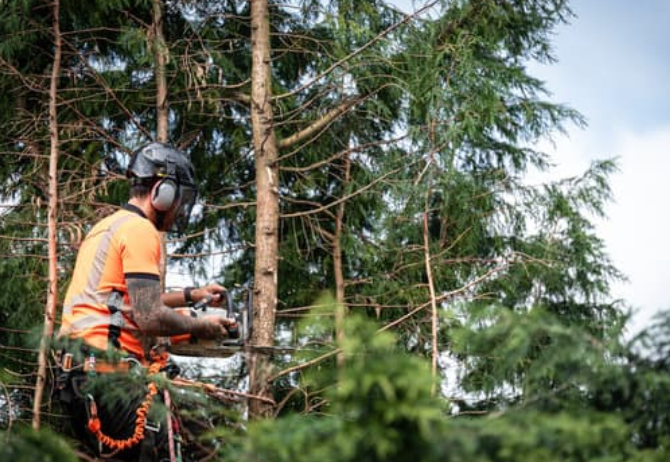
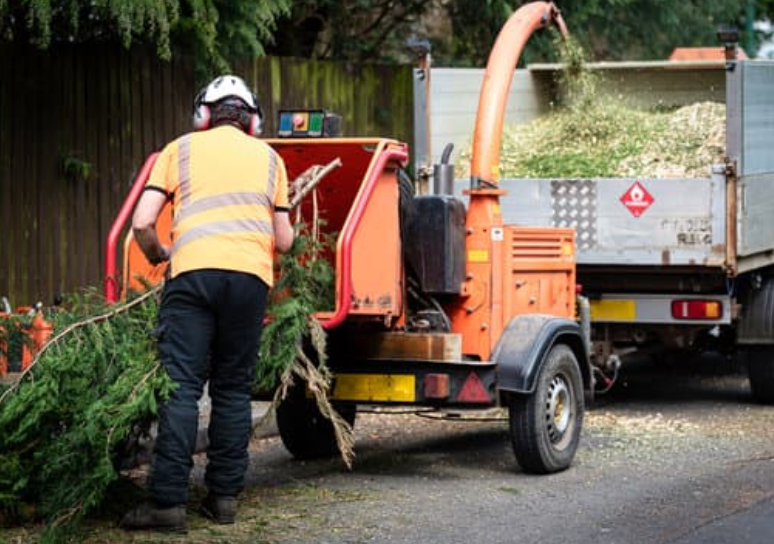
- The work itself -- Felling, crown reduction, pollarding, hedge cutting or stump grinding carried out to British Standard BS3998 by NPTC/Lantra-trained operators, using the kit the site calls for – a chipper and rigging in a tight garden, a 360 excavator and timber crane on a bigger clearance.
- Clear-up and completion -- Arisings are chipped, logged or removed as agreed and the site's left tidy. On commercial or council-related jobs you can get written confirmation the work was carried out to the required standard.
Roughly What It Costs, Before a Site Visit Confirms the Number
| Core coverage zone | Extended coverage zone | |
|---|---|---|
| Example areas | Glasgow, Renfrew, Paisley, Clydebank, Rutherglen, Cambuslang, Giffnock, Clarkston, Bearsden, Bishopbriggs, Hamilton, East Kilbride | Strathblane, Killearn, Balfron, Fintry, Kippen, Stirling, Bo'ness |
| Typical booking-in time | Usually within a few working days | May need a specific day slotted in, since travel eats into the working day |
| Emergency storm or windblown work | Same-day where a crew's already working nearby | Prioritised by severity – a tree on a building or blocking a road comes first regardless of distance |
| Pricing | Standard day rate applies | Day rate plus a travel or call-out addition, confirmed at quote stage, not added afterwards |
| Site visit for a quote | Free, usually within the same week | Free, but sometimes scheduled alongside another job heading the same direction to keep it efficient |
Standard Patch or Further Out: What Actually Changes
| Core coverage zone | Extended coverage zone | |
|---|---|---|
| Example areas | Glasgow, Renfrew, Paisley, Clydebank, Rutherglen, Cambuslang, Giffnock, Clarkston, Bearsden, Bishopbriggs, Hamilton, East Kilbride | Strathblane, Killearn, Balfron, Fintry, Kippen, Stirling, Bo'ness |
| Typical booking-in time | Usually within a few working days | May need a specific day slotted in, since travel eats into the working day |
| Emergency storm or windblown work | Same-day where a crew's already working nearby | Prioritised by severity – a tree on a building or blocking a road comes first regardless of distance |
| Pricing | Standard day rate applies | Day rate plus a travel or call-out addition, confirmed at quote stage, not added afterwards |
| Site visit for a quote | Free, usually within the same week | Free, but sometimes scheduled alongside another job heading the same direction to keep it efficient |
How Covering Eight Council Areas Actually Shapes a Day's Schedule
Coverage this wide isn't just a promise that you're not too far away – it changes how a day actually gets planned. Glasgow Trees works out from a city-centre base along the M8, M74, M77, M80 and A82 corridors, and jobs tend to get grouped by which road they sit on rather than booked in strict date order. A call from Milngavie is often scheduled the same afternoon as one further out in Strathblane or Killearn, because they sit on the same route out of the city; a job in Greenock, by contrast, rarely gets paired with one in Hamilton, since the two pull a crew in opposite directions. That's part of why a call from somewhere further-flung, like Bo'ness or Kippen, sometimes waits for a day when another job is already heading that way rather than getting a standalone slot – it keeps the cost down rather than adding a wasted return trip to the quote. None of that changes what turns up once someone's on site: the same fully insured crew, working to British Standard BS3998, gives a free quote whether the drive in took five minutes or forty-five.
Town by Town Across the Footprint
Glasgow itself is the anchor – tenement backcourts on the South Side, sandstone villa gardens in the West End, and streets right across to the East End including Baillieston. Backcourt access is usually the deciding factor here: a shared close can mean carrying kit through by hand rather than driving a chipper up to the tree, which changes how a job gets scheduled more than the size of the tree does.
West along the Clyde corridor, the patch takes in Renfrew, Paisley and Johnstone, and out further to Clydebank and Dumbarton in West Dunbartonshire, and Greenock in Inverclyde. Greenock and the wider Inverclyde coastline see more exposed westerly winds off the estuary, which is exactly the ground where windblown-tree training and aerial rescue certification earn their keep after a storm.
South of the river, East Renfrewshire's suburbs – Giffnock, Clarkston, Newton Mearns, Barrhead – tend to have larger gardens with mature beech, copper beech and conifer specimens that have outgrown their original planting position, which is a big part of why this is one of the busier patches for crown reduction and pollarding work. Further south again, South Lanarkshire towns including Rutherglen, Cambuslang, Blantyre, Bothwell, Hamilton and East Kilbride round out the southern coverage, taking in mature woodland edges near Bothwell Castle and Chatelherault.
North of the city, East Dunbartonshire's Bearsden, Bishopbriggs, Milngavie and Kirkintilloch sit at the foot of the Campsie Fells, and coverage continues out into the more rural villages of Strathblane, Killearn, Balfron and Fintry. Properties out this way are more likely to have shelterbelts, farm hedging and larger blocks of amenity woodland than a single ornamental tree, so a job in this direction often calls for different kit to a town garden. Coverage extends further still towards Kippen, Stirling and Bo'ness for the right job, though a trip that far out gets built into the schedule alongside other work heading the same direction rather than treated as a standalone visit.
If your own street isn't named above, the honest answer is that coverage is really a driving radius built around these towns rather than a hard boundary – a call with your postcode settles it in a couple of minutes.
Coverage Questions People Actually Ask
What areas of Glasgow do your tree surgeons cover?
The core patch runs across Glasgow City itself plus Renfrewshire, East Renfrewshire, East Dunbartonshire, West Dunbartonshire, Inverclyde and parts of South Lanarkshire, with occasional jobs further out towards Stirling and Bo'ness. The town-by-town list further up this page names the specific towns; if yours isn't on it, call and ask rather than assuming it's out of reach.
Do you provide tree surgery services outside Glasgow city centre?
Most of the job volume is actually outside the city centre – tenement backcourts and West End gardens make up part of it, but the busier ground is the surrounding suburbs and towns: Giffnock, Clarkston, Bearsden, Rutherglen and similar. City-centre access, where there's a garden or street tree at all, tends to be the trickiest rather than the most common job.
How far will a tree surgeon travel for a job?
Comfortably as far as Hamilton, East Kilbride, Dumbarton or Milngavie without it changing the price. Beyond that – out to Strathblane, Killearn, Balfron, Fintry, Kippen, Stirling or Bo'ness – it's still covered, but the quote usually includes a travel or call-out addition to reflect the extra time on the road.
Do you cover both the North and South sides of Glasgow?
Yes. The North side – Bishopbriggs, Bearsden, Milngavie, Kirkintilloch – and the South side – Giffnock, Clarkston, Newton Mearns, Cambuslang, Rutherglen – both get regular work, and neither is treated as the main patch. Jobs get scheduled by what's booked in for that week, not by which side of the river they're on.
Is there an extra call-out charge for jobs outside central Glasgow?
Not for the core towns named on this page – Renfrew, Paisley, Clydebank, Rutherglen, Bearsden and similar all sit within the standard day rate. It's really the further-out rural jobs, or a genuine out-of-hours emergency, where a travel or time addition gets added, and that's always confirmed at quote stage rather than sprung on you afterwards.
How do I know which tree surgeon covers my specific postcode?
Rather than checking a coverage map, it's quicker to call with your postcode and a brief description of the job. That gets you a straight yes or no, plus a rough idea of when someone could get out to have a look at it.
Does coverage differ between Glasgow City Council and neighbouring council areas like East Dunbartonshire or Renfrewshire for tree protection purposes?
Each council runs its own Tree Preservation Order register and its own process around felling licence exemptions, so a protected tree in East Dunbartonshire is checked against a different register to one in Glasgow City or Renfrewshire. The tree work itself doesn't change council to council, but it's worth checking with the relevant council, or asking us to flag it, before a large garden tree is touched, since protected status isn't always obvious just by looking at it.
Do tenement backcourts, new-build estates and large suburban gardens need different equipment?
Very much so. A backcourt job often means everything – chipper, saw kit, ropes – has to be carried through a close rather than driven to the tree, so it's a smaller footprint but a slower carry. A new-build estate garden usually has decent vehicle access but younger, smaller trees that rarely need more than hand tools and a small chipper. A large rural garden or shelterbelt out towards Strathblane or Balfron is the other end of the scale again – enough space to justify bringing a 360 excavator, timber crane or FMO tractor and trailer for a bigger felling or clearance job. Knowing which of those three you're dealing with before turning up is most of the planning.
Do different councils in your coverage area process tree work notices at noticeably different speeds?
In practice yes, though it varies year to year depending on how busy each planning department is rather than following a fixed pattern. It's not something we can put a firm figure on, but where a job depends on a council response – a felling notice near a boundary, say – that's factored into how the job gets scheduled rather than assumed to move at the same pace everywhere.
The Call Costs Nothing, Wherever You're Based
A tree doesn't wait for a quiet week, and a leaning branch over a shed roof on one side of the coverage area is exactly as urgent as one on the other. Get in touch with your postcode and what's going on, and you'll get a straight answer on timing along with an honest, free quote before anything's booked in – no pressure, no obligation, whichever corner of the area you're calling from.
Glasgow Trees
Call 0141-483-7485