
Tree Surgeon in Stirling and the Forth Valley
- Trading as Glasgow's tree surgery specialists since 2005
- Fully insured, BS3998-standard tree work
- Free, no-obligation site visit quotes
Stirling's trees don't all sit in the same kind of ground. There are mature specimens in Old Town gardens overlooking the castle rock, riverside plantings along the Forth's flood plain, mixed parkland woodland around the University of Stirling's Airthrey estate, and out toward Bridge of Allan, Dunblane and Bannockburn, hedgerows and windbreak lines marking out farm and field boundaries rather than garden fences. That range of settings changes how a tree gets worked on - a climber on rope and harness suits a walled town garden backing onto a narrow lane, while a stump on a field boundary or a windbreak thinned after storm damage is a job for tracked machinery once ground conditions are checked.
Glasgow Trees brings its Glasgow-based tree surgery service out to Stirling along the M80 and M9, covering removal, crown work, hedge cutting, stump grinding and site clearance to British Standard BS3998. The team is fully insured, quotes follow a free site visit rather than a guess over the phone, and there's no obligation to book once you've seen the price.
What's included when a job spans Old Town gardens and open farmland
- Tree inspections and reports for mortgage, insurance or Tree Preservation Order queries
- Full tree removal and sectional dismantling close to buildings, driveways or power lines
- Rope and harness climbing for confined gardens where a mobile platform or crane can't get access
- Rigging and controlled lowering of heavy limbs over sheds, greenhouses or garden walls rather than free-felling them
- Crown reduction, crown thinning, crown lifting and crown cleaning
- Deadwood removal and formative or maintenance pruning
- Hedge cutting and trimming, including overgrown field hedges and windbreak lines
- Stump grinding to roughly 18 inches below ground, with the hole back-filled using topsoil and the leftover grindings
- Site and land clearance, including vegetation management ahead of a building or landscaping project
- Commercial ground maintenance for business premises or estates, run alongside one-off tree work rather than as a separate contract
- 24-hour emergency call-out for storm-damaged or dangerous trees
Not Included / Costed Separately
- Removing and disposing of large volumes of timber or chippings off-site is usually priced separately from the tree work itself
- Access narrower than a standard garden gate (the stump grinder needs at least a 1-metre gap) may need extra time or a different method, which affects price
- Checking and applying for Tree Preservation Order or conservation area consent is the owner's responsibility with the local council, though we'll flag a tree that looks likely to be protected
- Replanting or landscaping after clearance is a separate job, not automatically part of a removal quote
- Cutting near live overhead power lines needs specific live-line qualifications, which the team is currently completing, so that particular work is referred or coordinated with the network operator rather than taken on
- Any extra work spotted once we're on site is agreed with you first, never added to the bill afterwards
From site visit to a tidy finish, in four stages
- The site visit comes first -- There's no fixed price given over the phone. A qualified tree surgeon comes out to see the tree in its actual setting, whether that's a walled Old Town garden with one narrow access point or a field boundary near the Ochils where ground conditions decide whether tracked machinery can go on at all. Tell us roughly the size of the tree and why it's come up when you call, and a storm-damaged branch over a roof gets seen faster than a stump that's been sitting there for years. This is also where a Tree Preservation Order or conservation area status gets flagged if it looks likely to apply.
- A written price, nothing added later -- You get a figure for exactly what was discussed on site, and the visit itself costs nothing whether or not you go ahead. If something else turns up once work starts - a second unstable limb, or rot running further into the trunk than expected - that gets talked through with you before anything more is done, not added to the invoice afterwards.
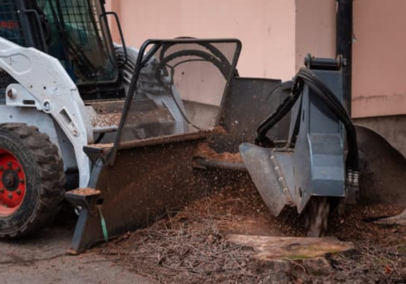
- The work, matched to what the ground allows -- A climber on rope and harness suits a walled garden backing onto a lane, where there's no room for a platform or crane to work. A windbreak thinned after storm damage, or a stump sitting on a field boundary, is more often a job for the 360 excavator or stump grinder, once the ground's been checked for how much weight it will safely carry. Both are carried out to British Standard BS3998 by a fully insured crew - which method gets used is a decision made on site, not a default applied regardless of the setting.
- Clean-up, and a second visit only where a job needs staging -- Brash is chipped and larger timber stacked or taken away as agreed; a ground-level stump gets back-filled with topsoil mixed through the leftover grindings. A bigger land clearance, or a long run of farm hedge, sometimes makes more sense split across two visits than pushed into one long day - and if that's the case, we'll say so upfront rather than leave it open-ended.
Why a hedge trim and a windbreak on a farm boundary aren't priced the same way
Rural jobs often carry a mobilisation cost that a small garden visit wouldn't - getting a 360 excavator or FMO tractor onto a farm or estate takes time an in-town job doesn't need, and soft or sloped ground near the Forth can add further time working out safe access before any cutting starts. Away from farmland, price comes down to the size and condition of the tree, how easily it can be reached, and whether the work sits close to a building, road, power line or a neighbour's boundary - a straightforward hedge cut or light prune on an accessible property costs less than felling a large tree by sectional dismantling next to a house, or grinding a stump where the access is tight. Emergency call-outs for storm damage get priced against those same factors, plus how urgent the risk actually turns out to be. None of that gets fixed over the phone - every quote follows the same free site visit, whether the tree in question stands in a farm field or a front garden, before a figure is written down.
How to judge tree surgeons operating out this far
| What to check | Glasgow Trees | Worth asking any tree surgeon |
|---|---|---|
| Insurance | Public liability cover in place for every job | Ask to see current proof of cover before work starts |
| Work standard | Carried out to British Standard BS3998 for tree work | BS3998 is the recognised UK standard - ask whether it's followed |
| Qualifications | NPTC/Lantra certificates covering felling, aerial rescue, rigging and dismantling, and machinery operation | Chainsaw and climbing work should be done by someone holding recognised NPTC/Lantra tickets |
| Rural and farm access | FMO tractor, forwarder trailer and 360 excavator qualifications for field, estate and farmland sites | Ask what happens if the job needs tracked machinery rather than a van and a chainsaw |
| Quotes | Free site visit before any price is given | Be cautious of a fixed price quoted without anyone seeing the tree |
| Tree inspection reports | NPTC Professional Tree Inspection qualified, for TPO or insurance queries | Useful if a mortgage lender, insurer or council needs a proper written report |
Telling a Real Risk From a Cosmetic One Round Stirling
The free site visit exists because a phone description can't settle whether a tree is a genuine problem or just looks like one, and round Stirling that call depends heavily on where the tree happens to stand. Out toward the Ochils, on an exposed farm boundary, the question is usually about wind: has a leaning conifer been rocking at the root plate through a winter of gusts coming off the hills, and is the next storm likely to put it through a stock fence or a shed roof. That's the exact situation the team's NPTC windblown-tree and aerial rescue certificates are built to handle, rather than a general chainsaw ticket covering it by default. Nearer the castle rock, inside the Old Town's conservation area, a similar-looking lean or a patch of deadwood on a mature lime usually raises a different kind of question - whether it's genuinely unsound or just untidy from the street below - and that's better settled with the NPTC Professional Tree Inspection qualification backing a written report than with a verbal guess on the doorstep. Getting either read wrong costs more than a disappointing quote: a stock fence gone through, or the corner of a sandstone terrace. Both still get assessed on the same free site visit, carried out to British Standard BS3998 by an insured crew, before any figure gets written down.
Old Town, Forth floodplain, then out to the Trossachs edge and Bo'ness
We reach Stirling along the M80 and M9 from the wider Glasgow base, and the town itself splits fairly cleanly into two kinds of ground: the Old Town below the castle, King's Park and Causewayhead under Abbey Craig on one side, where gardens are walled and access is often a single gate, and Bridge of Allan, Dunblane and Bannockburn on the other, where plots open out and field boundaries start to matter as much as garden fences. The University of Stirling's Airthrey estate sits inside that same footprint, its parkland woodland a different management job again to either a town garden or a farm hedge line. Further out, Doune and Callander mark the edge of the Trossachs, and Bo'ness to the east falls inside our regular Falkirk-area coverage - both sit close enough to the edge of a comfortable day's run that a job out that far is usually easiest to book alongside other Stirling-area work already on the books, rather than run as a one-off special trip. Low-lying ground near the Forth is worth flagging on its own: it can stay soft well after rain has stopped, which affects when tracked machinery can safely go on more than it would on higher ground closer to town.

Questions Stirling customers ask us
Do I need permission to remove a tree in Stirling?
It depends on whether the tree has a Tree Preservation Order on it or sits within a conservation area - if either applies, you'll need the council's consent before any cutting starts. We'll flag it during the site visit if a tree looks likely to be protected, but checking directly with Stirling Council is the safest way to confirm before work begins.
How much notice do you need for emergency tree work?
For genuinely dangerous situations, such as a storm-damaged tree hanging over a road, roof or driveway, we run a 24-hour emergency service and aim to get someone out as soon as possible. For routine pruning, removal or stump work, booking a site visit ahead of time lets us plan around access and whatever equipment the job needs.
Can you grind a stump if access is tight?
The stump grinder needs a gap of at least a metre to reach the stump, so a narrow side passage or a gate built over since the tree went in can be a problem. Tell us about access when you get in touch and we'll give you a straight answer on whether the grinder will fit or whether another method is needed.
What happens to the branches and timber afterwards?
Brash and smaller branches are chipped on site as standard. Larger sections of timber can usually be left with you for firewood, or taken away - flag your preference when you book, since removing a large volume of timber is generally priced separately from the tree work itself.
Do you carry out tree inspections for insurance or mortgage reports?
Yes - inspection work is carried out under an NPTC Professional Tree Inspection qualification, the relevant credential for a proper written report rather than a verbal opinion. That covers situations like a mortgage lender wanting confirmation a tree isn't a risk to a property, or an insurance claim following storm damage.
Is the quote really free if I decide not to go ahead?
Yes - the site visit and quote cost nothing and there's no obligation to book. We'd rather see the tree in person and give an honest figure than guess over the phone and get it wrong.
Do you clear land or hedgerows for a farm or building project around Stirling?
Yes - site and land clearance is part of the regular work, including cutting back overgrown hedgerows and windbreak lines and clearing vegetation ahead of a building or landscaping project. On larger areas we'll usually talk through whether it makes sense to do the work in one visit or stage it over two.
Can heavy machinery get onto soft or sloped farmland safely?
That's assessed on the site visit rather than guessed at beforehand - ground that's fine in dry weather can be too soft for a tracked excavator after a wet spell, particularly on low-lying fields near the Forth. If the ground isn't right on the day, we'll agree an alternative method or a different date rather than risk getting stuck or damaging the field.
What if a tree sits right on a boundary with a neighbour or a farm next door?
We'll ask who owns the tree before quoting, since that affects who needs to give permission for the work. Boundary trees can also need care around which side branches are removed from and where cut material falls, which we'll talk through on the site visit.
Book a free Stirling site visit
Storm damage, an overgrown hedge or a stump that's been sitting there for years - the earliest a job gets sorted is usually the cheapest, since deadwood, storm-loosened limbs and stump regrowth only get harder to deal with the longer they're left. Get in touch for a free, no-obligation site visit and a straight answer on what the work involves.
Glasgow Trees
Call 0141-483-7485