Tree Surgeon Milngavie Glasgow: Tree Removal, Pruning and Stump Grinding
- NPTC-qualified tree inspection before any felling decision, so a boundary tree gets a proper structural read rather than an automatic fell
- Rope-and-harness access and aerial rescue training for reservoir-edge gardens machinery can't reach
- A written site visit that costs nothing and carries no obligation to book afterwards
Milngavie's back gardens don't stop at the fence the way plenty of suburban plots do - many run straight into Mugdock Country Park or the rougher ground along the West Highland Way, so the beech, oak and conifer trees we get asked about here are often mature, sometimes older than the house they're standing next to, with roots and canopy that a lone garden specimen never has to contend with. That's the job that keeps us busy locally: a tree that's outgrown its spot, gone unsafe, or needs bringing back under control before it starts causing problems for a fence, a roof or a neighbour's light. It's a different trade to trimming a young tree on a new-build estate, and having a tree surgeon used to woodland-edge gardens rather than isolated garden specimens makes a real difference to how the job gets planned.
That pattern shapes how we work here more than a general company blurb could: reading a beech that's shared a boundary with woodland for decades properly - checking root plate movement and deadwood extent, not just quoting a fell - takes a different level of judgement than sizing up a young garden tree. We've been doing this work as Glasgow Trees since 2005, and every reduction, pollard or felling we carry out in Milngavie follows British Standard BS3998 with full insurance behind it. The standard on paper matters less than whether the person doing the reading has actually stood under enough of these boundary trees to tell settled ivy cover from a genuine lean.
What's included in a Milngavie tree job - and what isn't
- Full tree removal and felling, sectional dismantling where a tree is too close to a house, fence or road to fell whole
- Crown reduction, crown thinning and crown lifting for trees overshadowing gardens or blocking light from windows
- Pollarding and coppicing for trees that are managed on a cutting cycle rather than left to grow naturally
- Dead-wooding: removing dead or hanging branches from an otherwise healthy tree, a common request on older beech and sycamore
- Stump grinding down to below turf or planting level once a tree has been felled
- Hedge cutting and trimming carried out alongside tree work on the same visit, including large overgrown conifer hedges
- Wood chipping and removal of arisings, with logs left for the customer or taken away as agreed
- Emergency and storm work: making a windblown, split or hung-up tree safe, including trees leaning over access routes after weather events
- Site and ground clearance for developers, housing associations, golf courses and other commercial clients, including method statements and risk assessments where required
- Advice on whether a tree in a Milngavie garden is likely to fall under a Tree Preservation Order or conservation area control before any work is booked
Not Included / Costed Separately
- Formal Tree Preservation Order or conservation area consent applications: we'll tell you what we think applies and help word a straightforward application, but East Dunbartonshire Council handles the decision and the statutory waiting period, which we can't shortcut
- Ecological surveys: if a tree is inside or bordering ancient woodland near Mugdock and there's a reasonable chance of bat roosts or nesting birds, a specialist ecological check may need to happen first, and that's a separate cost outside our quote
- Replanting, landscaping or turf repair after a tree or stump is removed
- Removing very large volumes of timber by grab lorry, where a bigger tree has produced more usable timber or brash than a standard chip-away covers - this gets priced separately once we see the volume
- Repairing driveways, lawns or soft ground damaged by access for larger machinery, which we'll flag and discuss before the work starts if the site looks tight
- Any additional work found once a tree is opened up (for example hidden decay changing a reduction into a felling) - we stop and talk to you before doing anything beyond the original quote
How a Milngavie tree job runs, start to finish
- What you tell us on the first call -- Species if you know it, roughly where it's growing, and what's brought it to a head - a limb down after wind, a lean that's started worrying you, or a crown that's simply outgrown the garden. Mention straight away if the tree sits near Mugdock Country Park's boundary or a reservoir bank, since it changes how we plan getting equipment to it.
- A site visit built around reading the tree, not quoting a fell -- Someone from the team walks the garden, looks at the tree itself - species, decay, root plate movement, deadwood - and the access: garden width, slopes, fences, overhead lines, and whether Milngavie's position next to the park makes a TPO or conservation area check worth doing before anything's booked.
- One written price, with anything else sorted before a date's fixed -- The quote sets out what's included - felling method, whether stump grinding and chipping are part of it, anything that might add cost once we're into the job. If the work needs a road closure, a pavement notice, or a word to neighbours about noise or shared driveway access, that gets arranged at the same time rather than left until the day.
- Climbing, rigging and the cut itself -- Hazardous limbs come down before the main stem on any sectional job, arisings get chipped or logged as agreed, and a stump gets ground out there and then if that's part of the quote - climbing and rope work where the access won't take a machine, ground-based methods where it will.
- A walk round the garden before we invoice -- Site's left tidy, timber and chippings dealt with as agreed, and we go round the garden with you before anything's billed, so anything you're not happy with gets sorted while the van's still outside.
Rough costs for tree work near Milngavie's woodland gardens
Tree removal in the UK typically runs from around £150 for a small garden tree up to roughly £4,800 for a large, mature specimen that needs careful sectional dismantling because of its size or a tight access route - these are the sort of figures quoted industry-wide by sites like MyJobQuote, Checkatrade and MyBuilder, and they hold up reasonably well for the west of Scotland too. A day's labour for a tree surgery team generally sits between £180 and £250, which is a useful reference point if you're comparing quotes for crown reduction, pollarding or a half-day's hedge cutting rather than a single felling job.
Milngavie adds a couple of its own variables. Gardens backing onto Mugdock Country Park or the reservoir land often mean longer access for kit, or a need to work with hand tools and rope access rather than driving a chipper right up to the tree, and that adds time. If a tree turns out to be covered by a TPO, the council process itself is free but the waiting period (typically several weeks) affects timing rather than price. None of this replaces an actual site visit - a fair price for felling a 15-metre conifer with good garden access looks nothing like the price for the same height tree overhanging a boundary fence with a two-metre gap to squeeze equipment through, so treat any figure here as a starting point rather than what you'll be charged.
Reduction, pollarding, felling or grinding - matching the work to the tree
| Type of work | What actually happens | Best suited to | Typical price indicator |
|---|---|---|---|
| Crown reduction | Selective cutting back of outer branch growth to reduce height and spread while keeping the tree's natural shape | A mature tree close to the house that's sound but overshadowing windows or a patio | Roughly £200-£700 depending on size and access |
| Crown thinning | Removing a proportion of smaller branches through the crown to let more light and wind through | Dense-canopied trees causing heavy shade, or acting as a wind sail in exposed gardens near the park | Roughly £150-£500 |
| Crown lifting | Removing the lowest branches to raise the canopy above a path, drive or fence line | Trees encroaching on access routes or overhanging a neighbour's boundary | Roughly £150-£450 |
| Pollarding | Cutting back to a framework of main branches on a repeating cycle, rather than a one-off reduction | Trees already managed this way historically, or where size must be kept permanently in check | Roughly £200-£600 |
| Felling and removal | Taking the tree down whole or in sections, then clearing the arisings | Dead, dying, dangerous or simply unwanted trees where keeping it isn't practical | Roughly £150-£4,800 depending on height, girth and access |
| Stump grinding | Grinding the stump below ground so the area can be turfed, planted or paved over | After felling, where a stump left in the ground is a trip hazard or blocks replanting | Roughly £100-£350 depending on stump diameter |
| Emergency storm work | Making a windblown, split or hung-up tree safe, usually arranged for the same day | Storm damage, branches caught in neighbouring trees, or a trunk blocking a drive or path | Priced on the day, reflecting urgency and risk involved |
Why Milngavie's Boundary Trees Need Rope Access and a Trained Eye
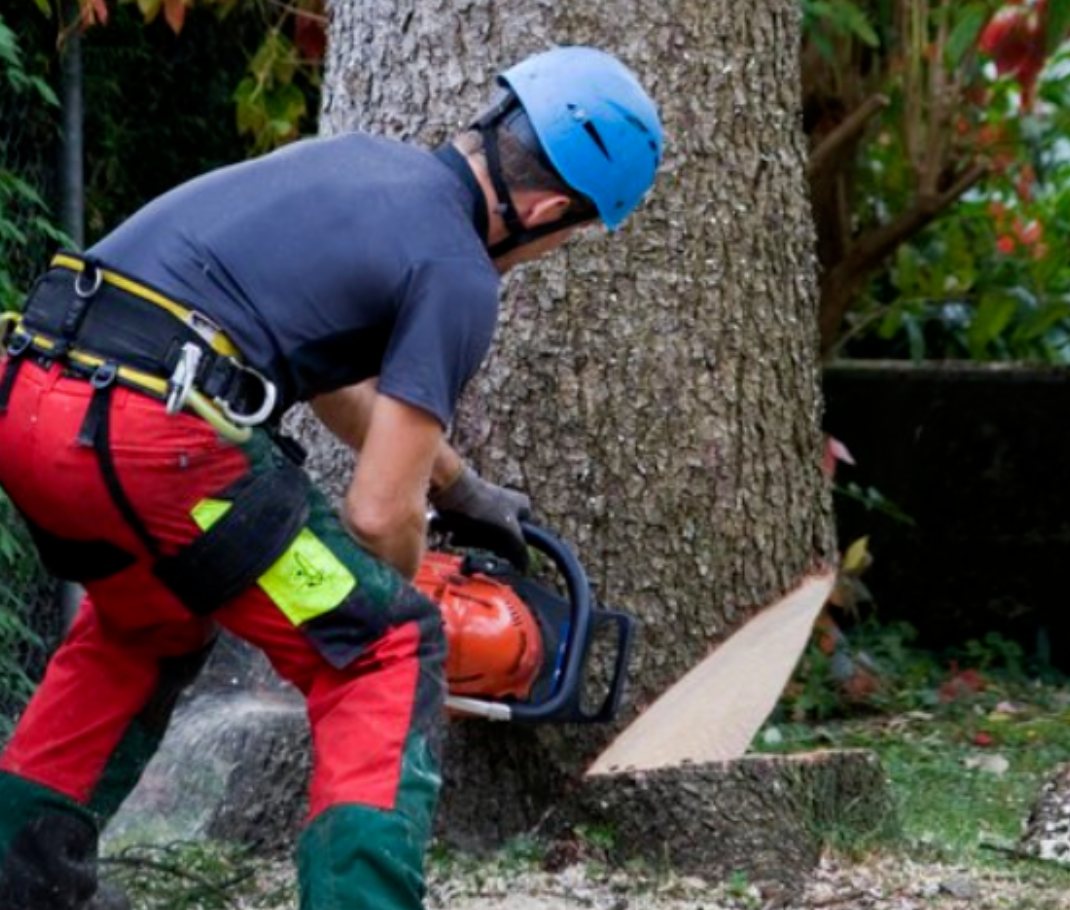
Rope and harness work is the default in Milngavie more than in a lot of the areas we cover, simply because of where the trees are. A boundary beech backing onto Mugdock's woodland, or a conifer on the reservoir bank at Craigmaddie, often sits too far from a driveway for a chipper or crane to get anywhere near it, so climbing the tree and lowering sections down by rope is the only realistic way to take it apart safely. That's what the team's certificates in chainsaw work from rope and harness, aerial rescue, and rigging and dismantling are actually for, rather than a general felling ticket that assumes ground-based kit will always reach.
Deciding whether a tree needs any of that work in the first place is a separate skill from doing the climbing, and it's the one that gets undervalued. Ivy cover, deadwood in the crown, a lean that's sat unchanged for years - none of it automatically means a tree's unsafe, and reading it wrong either way either costs the customer money on a fell that wasn't needed or leaves a genuine risk standing over a fence line. NPTC Professional Tree Inspection training runs through how we approach that first look, so a garden visit ends with a structural read - decay, root plate movement, deadwood extent - instead of a felling quote presented as the only option.
Mugdock has been managed as parkland for long enough that some of the boundary trees bordering Milngavie gardens have never been touched by anyone doing this for a living, and getting the standard right on a tree like that matters more than on a young garden specimen that's easy to replace if a call goes wrong. British Standard BS3998 sets out how that reading, and any cutting that follows it, has to be planned and recorded, and full insurance sits behind every visit whether the outcome is a full felling or a decision to leave the tree exactly as it is.
Milngavie, Mugdock and the ground we cover from here
Milngavie itself, from the town centre streets down to the gardens fringing Mugdock Country Park, is where most of our calls in this part of East Dunbartonshire come from. The park's ancient woodland and the old droving routes around Mugdock Castle mean some boundary trees here are genuinely old and worth a proper look before any cutting decision, and the Craigmaddie and Mugdock reservoirs - built in the 1850s to supply Glasgow's drinking water and still working land today - sit close enough to some gardens that access and any impact on the catchment area are something we ask about on the initial call, even if it rarely changes what work is needed. Milngavie is also the official start of the West Highland Way, which brings its own steady footfall past woodland edges where fallen or leaning trees near the path need dealing with promptly rather than left as a hazard.
Beyond Milngavie we cover neighbouring Bearsden and Kirkintilloch, and further out towards Strathblane, Killearn, Balfron and Fintry where gardens back onto the Campsie and Blane Valley countryside in much the same way. The wider service area runs across Glasgow, Renfrewshire, Lanarkshire and West Dunbartonshire, but Milngavie's woodland-edge setting is different enough from a typical suburban street that flagging it when you first get in touch helps us plan the right access and equipment before we arrive.
Milngavie tree work: the questions people actually ask
What does tree surgery cost in Milngavie?
It depends heavily on the tree and the site. As a rough UK-wide guide, tree removal runs from around £150 for a small tree up to roughly £4,800 for a large, difficult one, and a day's labour for pruning or crown work sits between £180 and £250. Milngavie gardens backing onto Mugdock or the reservoir land sometimes need longer access or hand-tool work rather than driving equipment right up to the tree, which can push a job toward the higher end of these ranges. A firm figure only comes from seeing the tree and the access in person.
Do trees near Mugdock Country Park in Milngavie have special protection?
Some will, some won't - it depends on the individual tree, not just its proximity to the park. Trees inside a conservation area or covered by an individual Tree Preservation Order need council consent before work goes ahead, and East Dunbartonshire Council is the authority that manages TPOs for this area. We check this as part of our site visit and will tell you honestly if we think an application is needed before any work is booked in.
How do I find out if a Milngavie garden tree has a TPO?
East Dunbartonshire Council holds the TPO register and can confirm whether a specific tree is protected, either individually or as part of a group order. We're happy to flag anything that looks likely to be covered when we visit, but the council's register is the definitive source, and getting that confirmed before work starts avoids any awkward conversations afterwards.
Can a tree surgeon safely remove large conifers common in Milngavie gardens?
Yes - tall Leylandii and other conifer hedging grown out into full trees is one of the more common jobs we're called out for locally. They're usually straightforward to fell if there's clear space to drop them, but in a tighter garden we'll dismantle them in sections from the top down using rope and rigging techniques, which our team is trained and certified for.
How quickly can emergency tree removal happen after storms in Milngavie?
We prioritise anything genuinely dangerous - a leaning or partially fallen tree blocking a road, driveway or the West Highland Way path, or one resting against another tree under tension - and aim to get out the same day where we can. Less urgent storm damage, like broken branches still safely up in the canopy, gets scheduled in the days following, once the immediate risks in the area are dealt with.
Are Milngavie tree surgeons experienced with mature woodland-edge properties?
That's a fair thing to ask, because it's a genuinely different job from a lone garden tree. Our team's certification covers large tree felling, windblown trees and aerial rescue specifically because that's the kind of work mature, park-adjacent gardens tend to throw up, and rope and harness access lets us reach boundary trees that machinery simply can't get close to.
What's included in a professional tree survey in Milngavie?
A proper inspection looks at species, age and structural condition, checks for decay, dead wood, included bark or root plate movement, and considers the tree's setting - how close it is to buildings, boundaries or paths, and whether it falls under a TPO or conservation area. Our NPTC Professional Tree Inspection qualification covers exactly this, and the outcome is a written assessment rather than just a felling quote, so you can make an informed decision rather than defaulting to removal.
Can I get a same-day quote for tree work in Milngavie?
For straightforward jobs where the tree and access are easy to describe over the phone or by photo, yes, we can often give an indicative figure quickly. For anything with real complexity - close to a boundary, a possible TPO, or awkward access near woodland - we'd rather see it in person before quoting a firm price, which usually means a visit within a few days rather than the same afternoon.
Do tree surgeons offer stump grinding services in Milngavie?
Yes, stump grinding is a standard part of what we offer, either straight after a felling job or as a standalone visit for a stump that's already been sitting in a garden for years. It's not automatically bundled into every felling quote, so it's worth asking for it explicitly if you want the area clear for turf or planting afterwards.
How much does hedge trimming cost alongside tree surgery in Milngavie?
Hedge cutting is usually priced by length and height rather than folded silently into a tree quote, so if you've got an overgrown conifer hedge alongside a tree that needs work, mention both when you book - doing them on the same visit is normally more cost-effective than two separate call-outs, and we'll break the price down so you can see what each part costs.
Get a straight answer on your Milngavie tree before winter weather makes the decision for you
A beech or oak that's already shedding deadwood into a neighbour's garden near Mugdock doesn't wait for a convenient month, and once autumn winds start testing a lean that's been there for years, a straightforward reduction can turn into an emergency call-out instead. Book a site visit while the job's still a planned one rather than a panic - there's no charge for the visit and no pressure to go ahead afterwards, and the written quote will tell you plainly if a tree's fine as it is.
Glasgow Trees
Call 0141-483-7485