
Commercial Highways and Trackside Arboriculture in Glasgow
- Team trained to NPTC/Lantra standards across chainsaw work, rigging, aerial rescue and windblown-tree recovery
- Fully insured for work adjacent to live roads and rail corridors
- Free, no-obligation site visits and quotes for one-off jobs and ongoing maintenance contracts
If you're responsible for keeping a road, rail corridor or embankment clear of encroaching vegetation, you'll know it's a different job from cutting back a garden hedge. Commercial highways and trackside arboriculture in Glasgow means working to a contract, a programme and often a traffic management or possession plan, which changes how the work is priced, staffed and carried out compared with a domestic tree job. Glasgow Trees has worked across the city and its surrounding council areas since 2005, and the crews who take on highways and trackside contracts are the same ones who handle everyday tree removal, crown reduction and site clearance for householders and businesses, so the same British Standard BS3998 methods and the same insurance cover apply whether the tree in question is in a back garden or six feet from a live carriageway.
Whether you're a facilities manager dealing with a line of self-seeded sycamore pressing into a boundary fence, a housing association with overgrown verges along an access road, or a main contractor needing a subcontracted arborist team for a defined stretch of embankment, the process starts the same way: work out what's actually there, decide what's genuinely a hazard rather than just untidy, and plan the cut, the access and the traffic or possession arrangements before anyone picks up a saw. It sits alongside the wider range of work the team carries out, from routine [[LINK:https://www.glasgowtrees.co.uk/hedge-cutting.html|hedge cutting and trimming]] to full [[LINK:https://www.glasgowtrees.co.uk/site-clearance.html|site clearance]] for larger commercial plots.
What counts as highways and trackside arboriculture, and what doesn't
- Clearance of vegetation encroaching on the highway boundary, sightlines, signage or street lighting
- Emergency response to a fallen tree blocking a road or rail line, including making the site safe and removing the obstruction
- Cutting back overhanging branches that reduce headroom below the standard clearance needed for buses, HGVs or rail overhead line equipment
- Removal of self-seeded and volunteer growth (sycamore, ash, buddleia) along verges, embankments and cuttings before it establishes a root system that damages drainage or fencing
- Felling or dismantling of individual hazard trees identified during a highways or rail corridor inspection
- Ongoing maintenance contracts covering a defined stretch of road, verge or trackside on a scheduled cycle rather than a single visit
- Removal and chipping of cut material, with waste taken off-site unless a client wants brash left on site for their own disposal
- Supply of trained staff and equipment (chainsaws, chippers, stump grinders, and where needed a 360 excavator or telehandler) for a contractor's own highways or rail project
Not Included / Costed Separately
- Traffic management equipment and lane closures themselves are usually arranged and costed separately, through the client's own traffic management contractor or council permit, though the team will work to whatever scheme is put in place
- Direct engagement on Network Rail infrastructure as a principal contractor sits with RISQS-approved rail specialists; where this business supports rail-adjacent work, it's typically on private sidings, adjoining land or as agreed with the managing contractor rather than as a Network Rail principal
- Out-of-hours or night working carries a different rate to a standard daytime visit, and needs to be agreed in advance so the right crew and lighting are booked
- Root cutting near live cabling, drainage or buried services is priced separately once a survey has confirmed what's underground
- Reinstatement of verges, fencing or hard surfaces disturbed during access is not included unless specifically agreed and quoted for
- Stump removal below ground level (as opposed to grinding to a standard depth) costs extra and depends on what's planned for the site afterwards
How a roadside or rail corridor job actually gets from enquiry to a cleared site
- Enquiry and scope check -- You describe the site, whether it's a one-off clearance or a proposed maintenance contract, and roughly where access sits relative to the road or line. This is also the point where any permit or possession lead time gets flagged, since traffic management approvals and rail access can take longer to arrange than the cutting itself.
- Site visit and hazard review -- A member of the team walks the stretch in question, identifying which trees or vegetation are genuinely obstructing sightlines, signage, lighting or clearance envelopes versus what can be left. On embankments and cuttings this includes a look at root-plate stability and ground condition, since a tree that's fine on flat verge ground can behave very differently on a steep, waterlogged slope above a live carriageway or line.
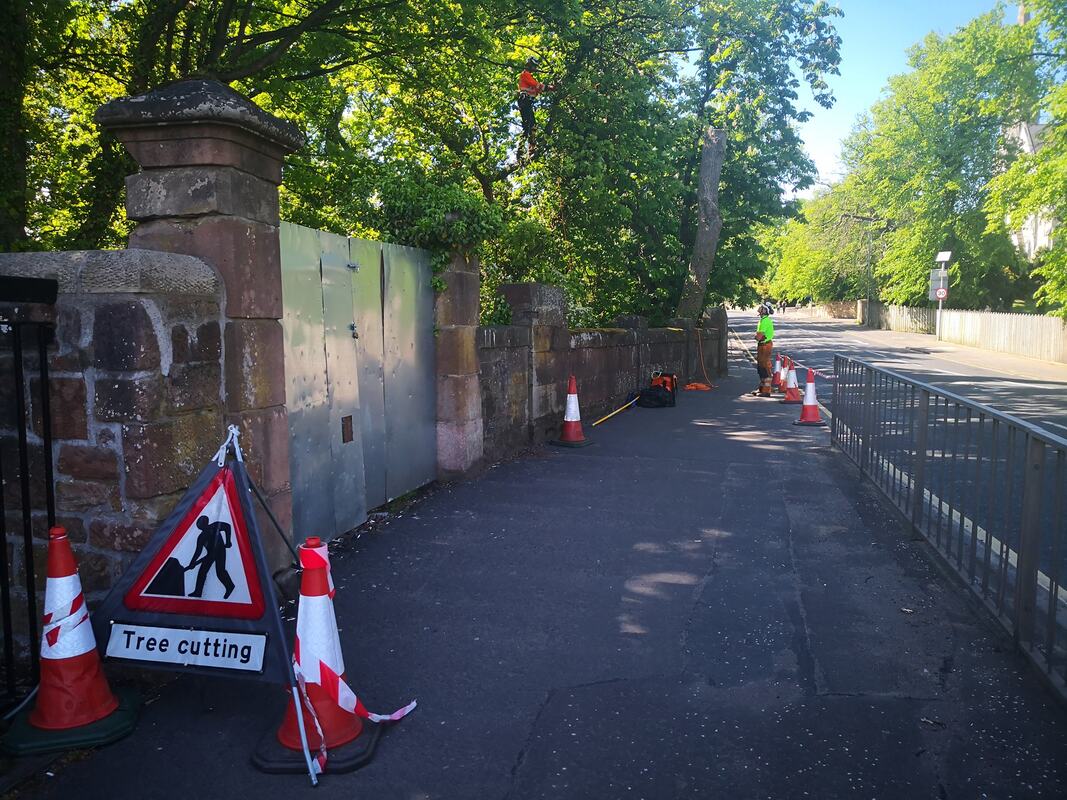
- Traffic management or possession arranged -- For roadside work, signage, cones, lighting and any lane closure are agreed with whoever holds the permit for that stretch of road, and the crew's high-visibility clothing meets the class 3 standard expected in a live traffic environment. For anything genuinely trackside, this is where the client's own rail-approved contractor or Network Rail process takes the lead, with our crew working to their possession and safety system rather than operating independently on the running line.
- The work itself -- Cutting, felling or dismantling is carried out using the appropriate method for the site: rope and harness access for awkward embankment positions, rigging and lowering where material can't simply be dropped, and machine support (chipper, stump grinder, or excavator on larger clearance jobs) where ground and access allow it.
- Clearance and waste removal -- Cut material is chipped or removed from site rather than left to build up along a verge, unless a client specifically wants brash retained. On larger contracts this is scheduled to keep the working area tidy between visits, not just at the end.
- Sign-off and next visit -- For a one-off job, the site is checked over and handed back. For a maintenance contract, the next scheduled visit is agreed so the same stretch doesn't drift back into the state that prompted the original call-out.
What it costs to keep a corridor or verge clear
A short stretch of overgrown verge with easy access is a very different job from half a kilometre of embankment with restricted access and unstable ground, and that gap is exactly why this kind of work doesn't have a single published rate. Rail-side vegetation contracts are typically won by RISQS-approved specialist contractors through tender rather than a fixed price list, and highways vegetation work for councils and private clients is generally quoted per contract too, because the variables are too wide for a flat rate to mean much: the length of verge or line involved, how much vegetation needs to come out, whether traffic management or a rail possession has to be arranged separately, ground condition and access, and whether it's a single visit or a scheduled maintenance cycle over a year. A genuine, firm figure only comes after a site visit, which is free and without obligation, so there's no cost to finding out where a job actually sits before committing to anything.
Highways and trackside work set against a standard tree job
| Standard garden or commercial tree work | Highways and trackside arboriculture | |
|---|---|---|
| Access and site control | Usually straightforward, on private ground with normal working space | Needs traffic management, signage or a rail possession/permit before work starts |
| Working environment | Static, controlled ground conditions | Working near live traffic or an operational rail corridor, often on sloped embankments |
| PPE and visibility | Standard chainsaw PPE | Class 3 high-visibility clothing required, plus site-specific safety briefings |
| Pricing basis | Fixed quote after a straightforward site look | Tendered or contract-based pricing reflecting length, access and traffic/possession costs |
| Typical instruction | Homeowner or single business | Council, contractor, housing association or rail-adjacent landowner, often on a maintenance cycle |
Qualifications that matter once the site is a live carriageway or embankment
Telling a genuinely hazardous tree apart from one that's simply untidy matters more on a highways or rail corridor than almost anywhere else, which is where NPTC Professional Tree Inspection training comes in: it's the qualification behind deciding what actually needs to come out along a stretch of verge or embankment, rather than clearing more than necessary or leaving something that later comes down onto a road or line. Alongside that, the team holds NPTC/Lantra certification in the specific chainsaw and tree work disciplines a corridor site calls for: large tree felling, windblown tree recovery, aerial rescue, chainsaw from rope and harness, and rigging and dismantling, plus health and safety and first aid. On the machinery side, training covers stump grinders, wood chippers, a timber crane, FMO tractor and forwarder trailer, an FMO line skidder, a 360 excavator, a flail and a telehandler, which between them cover most of what a larger clearance or maintenance contract needs on the ground. None of this is a separate division bolted on for commercial contracts: it's the same fully insured team that carries out routine tree removal and crown reduction across the city, working to British Standard BS3998 whether the tree in question is next to a live carriageway or in a back garden.
Where road and rail corridor work actually happens around Glasgow
Verge and lineside growth on the damper ground around the Clyde valley, through Renfrew and Paisley, tends to build up faster between visits than it does on drier, better-drained sites, which is one practical reason a scheduled maintenance contract usually works out better value than waiting for an occasional clearance to become overdue. Glasgow's own road and rail network supplies plenty of that kind of growth to manage: the M8 corridor through the city centre and West End, the Clydeside routes, and the suburban lines out through Pollokshaws, Rutherglen and Cambuslang all carry lineside and roadside vegetation that needs managing on a cycle rather than as a single cut. Beyond the city, the same crews take on contracts along the M74 and M77 towards East Kilbride and Hamilton, since highways vegetation work is generally priced and scheduled around a specific route rather than a fixed radius from base. Further out, jobs on quieter rural roads and embankments towards Stirling and Falkirk are taken on where the length and value of the contract justify the travel, rather than as standard, close-in coverage.
Highways and trackside tree work: the questions that come up
Do you carry out tree and vegetation clearance along roadsides for councils?
Yes, this is a core part of the service, whether it's a single overgrown stretch or an ongoing maintenance contract for a housing association, business park or contractor working on a council's behalf. Roadside work is planned with the appropriate signage, lighting and traffic management for a live carriageway, and staff wear class 3 high-visibility clothing throughout.
What safety certifications are needed to work near live railway lines or busy roads?
For roadside work, staff need chainsaw and tree work certification (NPTC/Lantra) plus training in working safely in a live traffic environment, which the team holds. For work directly on live railway infrastructure, contractors typically also need Personal Track Safety (PTS) certification and RISQS approval, which sit with Network Rail's specialist principal contractors. Where a job is genuinely on the operational line rather than adjoining land, that work runs under the managing rail contractor's own safety system rather than as an independent instruction.
Can trackside vegetation actually cause train delays or safety issues?
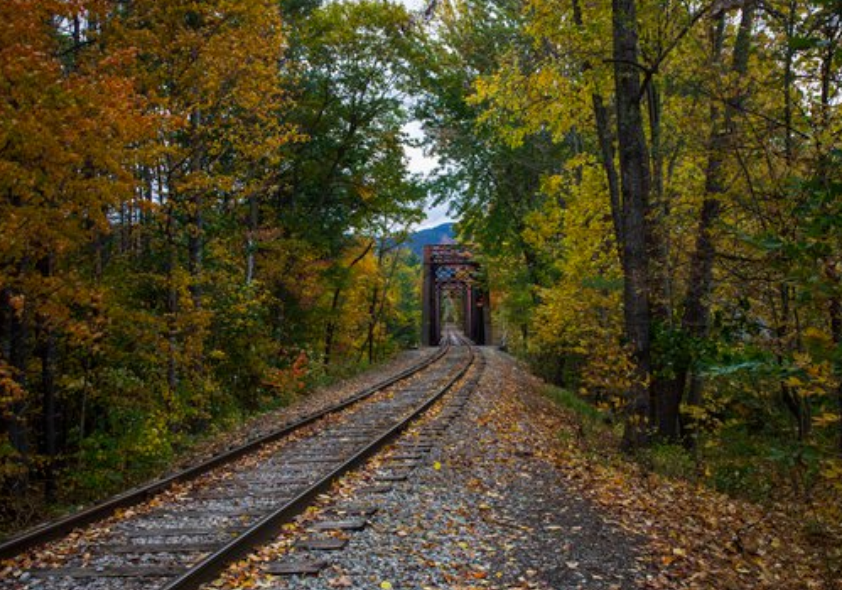
It can, and this is exactly why rail operators manage it as a scheduled programme rather than an occasional tidy-up. Overgrown vegetation can obscure signals and sighting distances, drop leaves that affect rail adhesion in autumn, and in the worst case a leaning or windblown tree can come down onto the line itself. Roots from self-seeded growth on embankments can also destabilise the slope over time, which is a slower but equally real risk.
Do you work with Network Rail or its contractors on vegetation clearance?
Direct principal contractor work on Network Rail's own infrastructure sits with RISQS-approved specialist rail contractors. Where this service supports rail-adjacent work, it's typically on private land, sidings or boundaries adjoining the railway, or as an agreed subcontractor role working to another contractor's rail safety system, rather than as an independent operator on the running line.
How is highway tree work planned around traffic management?
For anything within the highway boundary, signage, cones and any necessary lane closure are agreed in advance, either through the client's own traffic management arrangement or a council permit for the specific stretch of road. The crew works to whatever scheme is in place and times the cutting or clearance around it, rather than treating traffic management as an afterthought.
Do overhanging trees near roads need regular cutting back by law?
Landowners have a general duty to keep trees on their land from creating a hazard to the public highway, including maintaining clearance for vehicles, pedestrians and street furniture such as signs and lighting. There's no single fixed cutting schedule set out for every site, which is why a periodic inspection and maintenance contract tends to work better than waiting for a complaint or an obvious obstruction to appear.
Can you carry out emergency tree clearance after a road is blocked by a fallen tree?
Yes, emergency call-outs for a fallen tree blocking a road are handled as a priority, making the site safe first and then removing the tree and clearing the debris. Response time depends on where the site is within the coverage area and what's needed to access it safely, so it's worth calling as soon as the obstruction is identified rather than waiting.
Do you work at night or during road closures for highway tree jobs?
Night working and out-of-hours access are available where a job needs it, for instance where a road closure is only granted overnight or where daytime traffic volumes make daytime access impractical. This needs to be agreed and priced in advance so the right crew, lighting and safety arrangements are booked rather than arranged on the day.
How do you dispose of large volumes of cut vegetation from highway or rail corridors?
Cut material is generally chipped on site and removed rather than left to accumulate along a verge or cutting. On larger contracts, chipped material can sometimes be repurposed rather than sent to landfill, which is worth raising during the site visit if it matters to your project, since it depends on volume, species and what's practical for that particular site.
Don't let a manageable stretch turn into an emergency call-out
Vegetation along a road or rail corridor rarely gets less of a problem by leaving it, growth carries on through the next season and a hazard that's manageable now can become an emergency call-out later. If you've got a stretch of verge, embankment or boundary that needs a proper look, a site visit costs nothing and gives you a clear idea of what the job actually involves before anything is booked in.
Glasgow Trees
Call 0141-483-7485