Tree Lightning Protection in Glasgow
- Free, no-obligation site visit before any lightning protection quote
- Risk assessed by an NPTC-qualified tree inspector, not a blanket sales pitch
- Installed by climbers trained in aerial rescue and rope-and-harness work, so nothing gets spiked into the bark
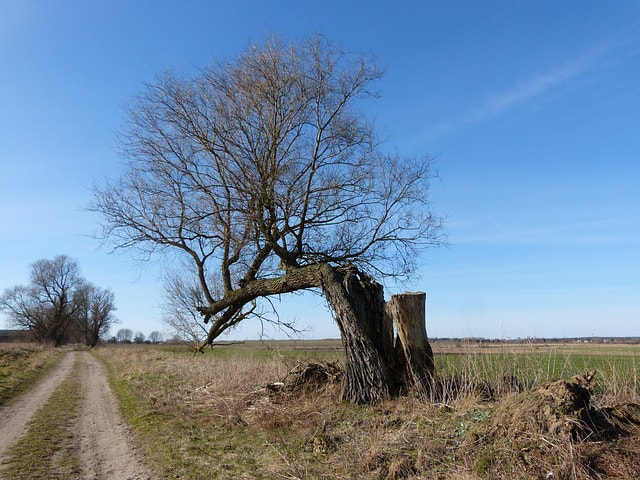
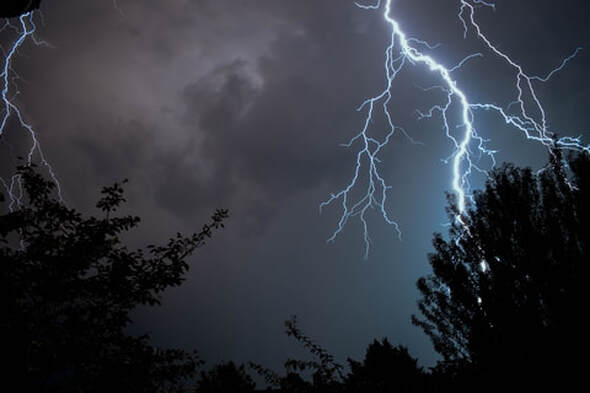
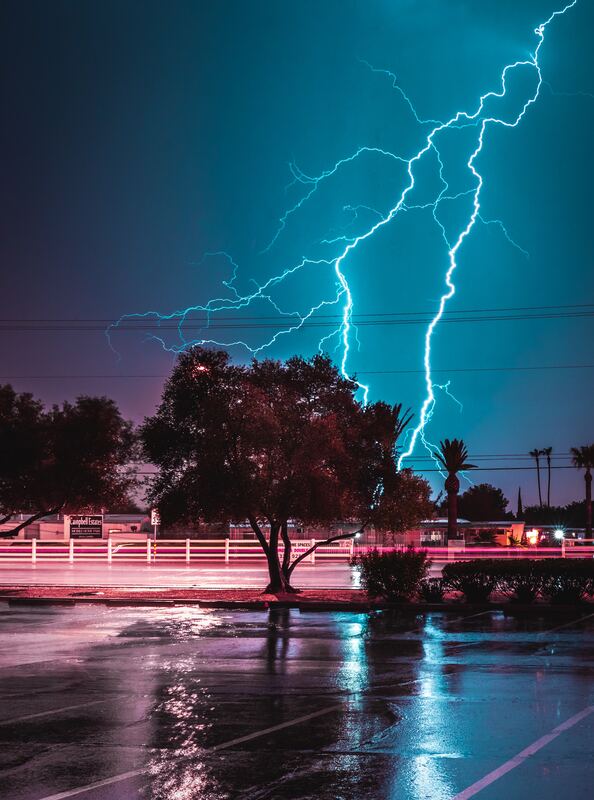
If you've got a tall specimen tree, an old beech on an estate boundary, or a conifer that stands clear above everything around it, tree lightning protection in Glasgow is worth arranging before the next storm rolls in, not after. Lightning finds the tallest conductive point nearby, and a tree standing alone on open or high ground, or one that towers over a roofline, is very often that point. When a strike does hit, the sap layer just under the bark boils almost instantly and the steam pressure can blow bark and splinters off the trunk with real force, split a stem from crown to root plate, or leave a wound that quietly rots out the heartwood over the following years. None of that is guaranteed on every strike, but on a mature, veteran, or particularly tall tree the consequences of getting it wrong are severe enough that most owners decide the modest cost of a proper conductor system is worth it.
We design and fit these systems ourselves, weighing up each tree on its own merits rather than fitting a conductor to everything we're asked to look at. A site visit costs nothing and carries no obligation, so if you're simply unsure whether your tree is genuinely at risk, that's the easiest way to find out before you spend anything.
Fitting a Conductor: What's In Scope and What Isn't
- A site assessment of the tree's height, species, crown shape, root spread and how exposed it is to open ground or high ground
- Checking proximity to buildings, overhead lines, and any buried services the earth point needs to avoid
- Design of an air terminal and down-conductor route that follows the trunk without crossing major branch unions or included bark
- Installation using rope-and-harness climbing access, never spikes driven into living bark
- Copper or aluminium tape or cable, fixed with clips designed to loosen and slide as the trunk girth increases with growth
- An earth rod or plate driven in at the base and bonded to the conductor
- A continuity check on the finished system so you know the run is actually connected end to end
- Advice on whether a wide or multi-stemmed crown needs more than one conductor run
- A photographic record of the finished job for your own file or to show an insurer
Not Included / Costed Separately
- Protection for the building itself -- domestic and commercial lightning protection systems on structures are a different discipline, quoted and installed separately
- Removing or making safe a tree that has already split or structurally failed from a previous strike -- that's emergency tree work, not protection, and is quoted on its own terms
- Testing or certifying an existing system fitted by someone else, without first inspecting it ourselves
- Submitting grant applications or insurance claims on your behalf -- we'll give you the facts about the tree and the work, but you make the application
- Any guarantee that a protected tree can't be damaged by a strike -- a conductor gives the energy a safer path to earth, it doesn't make a tree strike-proof
From First Call to a Tested, Earthed System
- Initial call -- Tell us where the tree is, roughly how tall it is, and why you're concerned -- a recent near-miss on a neighbouring tree, an insurer's question, or simply that it stands well above everything else nearby.
- Site visit and risk assessment -- One of our NPTC-qualified inspectors looks at the actual tree in person -- species, height, crown spread, soil type, how isolated or exposed it is, and how close it stands to a building or roofline -- before saying whether it genuinely falls into the higher-risk category.
- Design and written quote -- We decide whether a single conductor is enough or whether a wide or multi-stemmed crown needs more than one run, plan the route down the trunk away from branch unions, pick a suitable spot for the earth point, and put a firm price in writing.
- Installation -- Our climbers go up using rope and harness, never spikes, fit the air terminal above the highest point of the crown, run the tape or cable down the trunk secured with growth-tolerant clips, drive the earth rod, and bond the whole run together.
- Testing and sign-off -- We check continuity through the finished system, walk you through what's been fitted and where, and leave you with photographs of the completed work.
- Ongoing check-ups -- As the tree keeps growing, clips need loosening and the system benefits from a periodic look-over -- we'll tell you roughly when that should be rather than leaving you to guess.
Roughly £800 for a Single Stem, More for a Veteran Crown
For a single tall leader on a large landmark tree -- something in the region of 80 feet -- industry discussion among arborists puts a realistic figure at around £800 all in, split roughly evenly between materials (the conductor tape or cable, clips, air terminal and earth rod) and the labour of climbing, fitting and testing it properly. That's a reasonable starting point for a straightforward single-stem tree, but it moves up from there for a wide or multi-stemmed veteran needing more than one conductor run, for a tree with difficult access, or where the ground around the base makes a good earth connection harder to achieve. Worth flagging separately: lightning protection for a building is priced on a completely different scale, typically anywhere from around £300 up to £2,450 or more depending on the structure -- if you searched expecting that range, it's the wrong job for what we're describing here, since a tree conductor is a much smaller, lighter installation than a full building earthing system. Either way, a figure quoted without seeing the actual tree is only ever a guide -- a firm price needs a site visit, because height, stem count, access and ground conditions all move the number.
Conductor, Crown Reduction, or Leave It Alone
| Option | What's involved | Typical cost | Best suited to |
|---|---|---|---|
| Leave it as is | No intervention -- you accept the risk of a future strike | No upfront cost, but potential for a sudden and total loss of the tree | Lower, sheltered trees with little heritage or amenity value |
| Single conductor system | One air terminal and down conductor fitted to a tall, single-stem tree | Roughly £800 for a large specimen, materials and labour combined | Tall, single-leader trees standing near buildings or on open, high ground |
| Multi-conductor system | Two or more conductor runs across a wide or multi-stemmed crown | Above single-conductor pricing -- needs a site visit to price accurately | Veteran, multi-stemmed, or TPO/listed trees with several major leaders |
| Crown reduction instead of, or alongside, protection | Reduces overall height and sail area rather than redirecting a strike | Priced separately as a standard pruning job | Trees where a conductor isn't practical, or where height itself is the wider worry |
Who Makes the Risk Call and Does the Climbing
We've traded as Glasgow's tree surgery specialists since 2005, and a call about lightning protection almost always comes from someone who owns a tree that's genuinely out of the ordinary -- taller than everything nearby, older than the house it stands beside, or the last mature specimen left on the plot after neighbouring ground was cleared. Risk assessment on a job like this isn't guesswork: our NPTC Professional Tree Inspection qualification means someone trained specifically to read a tree's condition and structure is the one telling you whether protection is warranted, rather than whoever happens to answer the phone. The installation itself is carried out by climbers holding NPTC/Lantra certificates in aerial rescue and chainsaw work from rope and harness, which matters here because it means the crew can work right through a tall crown without resorting to spikes that would wound the bark on the very tree you're trying to protect. Every job, lightning protection included, is carried out to British Standard BS3998 for tree work, we're fully insured, and quotes cost nothing and commit you to nothing.
Which Trees Across the Region Actually Need This
Glasgow itself is where most enquiries start, and Pollok Country Park is a fair example of why -- a stand holding the city's tallest tree, a Sitka spruce over 33 metres, carries a genuinely elevated risk rather than a theoretical one. Head out toward East Renfrewshire and the ground itself starts working against a tree owner: gardens in Giffnock and Newton Mearns back onto higher ground climbing towards Eaglesham moor, so a mature specimen there stands more exposed than an equivalent tree lower in the city. The same logic applies heading north towards the Campsie and Fintry Hills, where villages such as Strathblane and Fintry sit on genuinely elevated, open ground -- a tall tree standing alone up there is about as textbook a lightning risk as this trade sees. Around Bothwell and Blantyre, mature policy woodland surrounding the old Bothwell Castle grounds turns up veteran trees worth a second look for the same reason. Beyond these, day-to-day coverage runs across Renfrewshire, West Dunbartonshire, South Lanarkshire, and out towards Stirling and Bo'ness, but it's a tree's height and exposure that decide whether this is worth doing, not simply which side of a council boundary it happens to sit on.

Straight Answers on Trees and Lightning Risk
Do trees actually need lightning protection installed?
Most don't. The trees worth protecting are the exceptions -- mature, veteran or particularly tall specimens, trees standing alone on open or high ground, or ones close to a building where a strike travelling down the trunk could throw debris or arc towards copper wiring and plumbing. An ordinary tree in a sheltered garden, surrounded by others of similar height, isn't in the same category, and we'll tell you that honestly rather than fitting a system you don't need.
How much does it cost to fit a lightning conductor to a large tree?
For a single tall leader on a large tree, a realistic starting figure sits around £800 all in, covering both materials and the climbing labour to fit it properly. That rises for multi-stemmed trees needing more than one conductor, for tricky access, or where the ground makes a good earth connection harder to achieve, so treat any figure quoted sight unseen as a guide rather than a firm price.
Which trees are most at risk of being struck by lightning?
Height and isolation matter more than species. Trees standing alone on open or high ground, ones that clear the surrounding canopy or roofline, and mature or veteran specimens with a large crown are the ones most exposed. A tree of the same species tucked in among others of similar height, lower down and more sheltered, carries a much smaller risk.
Can a lightning strike kill a mature tree instantly, or does the damage happen slowly?
Both are possible. A strike that travels down through the centre of the trunk can destroy enough living tissue in an instant to kill the tree outright, with bark blown off violently as the sap boils. A strike that runs down one side, or lower on the trunk, might split the stem rather than kill the tree immediately -- but the wound left behind can let in decay that weakens the tree slowly over the following years, so a tree that survives a strike still needs checking afterwards.
How is a lightning protection system fitted without harming the tree?
Access is by rope and harness rather than spikes, so the bark isn't wounded during installation. The conductor tape or cable is fixed with clips designed to be loosened and slid as the trunk keeps growing, rather than nailed or stapled in a way that would eventually girdle the stem, and the route down the trunk is planned to avoid crossing major branch unions.
Do you need to protect a tree only if it's near a building?
No -- proximity to a building raises the stakes because of the risk to copper wiring, plumbing and the structure itself, but an isolated tall tree in open parkland or a large garden, with no building anywhere near it, can still be worth protecting for the tree's own sake, particularly if it's a veteran or heritage specimen you'd rather not lose to a single storm.
How often does a tree lightning protection system need checking?
There's no fixed universal interval, but a periodic look-over makes sense as the tree keeps growing -- clips need loosening so they don't bite into the expanding trunk, and it's worth confirming the conductor run and earth connection haven't been disturbed by other work, storm damage, or ground movement nearby.
Can lightning protection be fitted to a tree that's already showing bark cracking from a previous strike?
It depends on how much structural damage that earlier strike left behind. If the crack is superficial and the tree's structure is otherwise sound, a system can often still be retrofitted to reduce the risk of a repeat strike causing worse damage. If the crack goes deep into the stem or there's significant decay already setting in, that's a structural safety question first, and any protection decision has to wait until that's been properly assessed.
Could a listed or veteran tree with a Tree Preservation Order qualify for help towards the cost of protection?
Some funding for veteran and heritage tree work does exist through council and heritage schemes, though availability and criteria vary and change over time, so we can't promise a specific grant applies to your tree. We're happy to give you the facts about the tree's condition and the work involved so you've got what you need to make an enquiry, but the application itself is something you'd need to pursue with the relevant body.
Have That Storm-Exposed Tree Looked At Now
A tree that's stood through decades of Scottish weather can still lose everything in one direct strike, and once the trunk has split there's no putting it back together -- protection only works if it's fitted before that happens. If you've got a tall, isolated or veteran tree you'd rather not gamble on, get in touch for a free, no-obligation site visit and an honest opinion on whether it's genuinely at risk.
Glasgow Trees
Call 0141-483-7485