
Tree Stump Removal in Glasgow: Grinding, Digging Out, and What It Costs
- NPTC/Lantra-certified stump grinder and excavator operators, not just chainsaw hands
- Free, no-obligation site visit before any price is given
- Fully insured, working to British Standard BS3998
If you've had a tree taken down and you're left looking at a stump in the middle of the lawn, you're not on your own -- it's one of the most common follow-on calls after a [[LINK:https://www.glasgowtrees.co.uk/tree-felling.html|tree felling]] job, and just as often from someone who's inherited an old stump from a previous owner. Grinding is the route most people take, so below is what's actually involved, what changes the price, and when a stump is better dug out than ground down. Full detail on the machinery and method is on our [[LINK:https://www.glasgowtrees.co.uk/stump-grinding-and-removal.html|stump grinding]] page, and you can check we reach your postcode on our [[LINK:https://www.glasgowtrees.co.uk/areas-we-cover.html|areas we cover]] page.
Most stumps don't need removing for any urgent reason -- plenty are left to rot down over a few years without causing harm. The usual reasons people ask for one to be ground out are wanting the ground back for a lawn, border, or driveway sooner, or because it's become a trip hazard or an eyesore in an otherwise tidy garden.
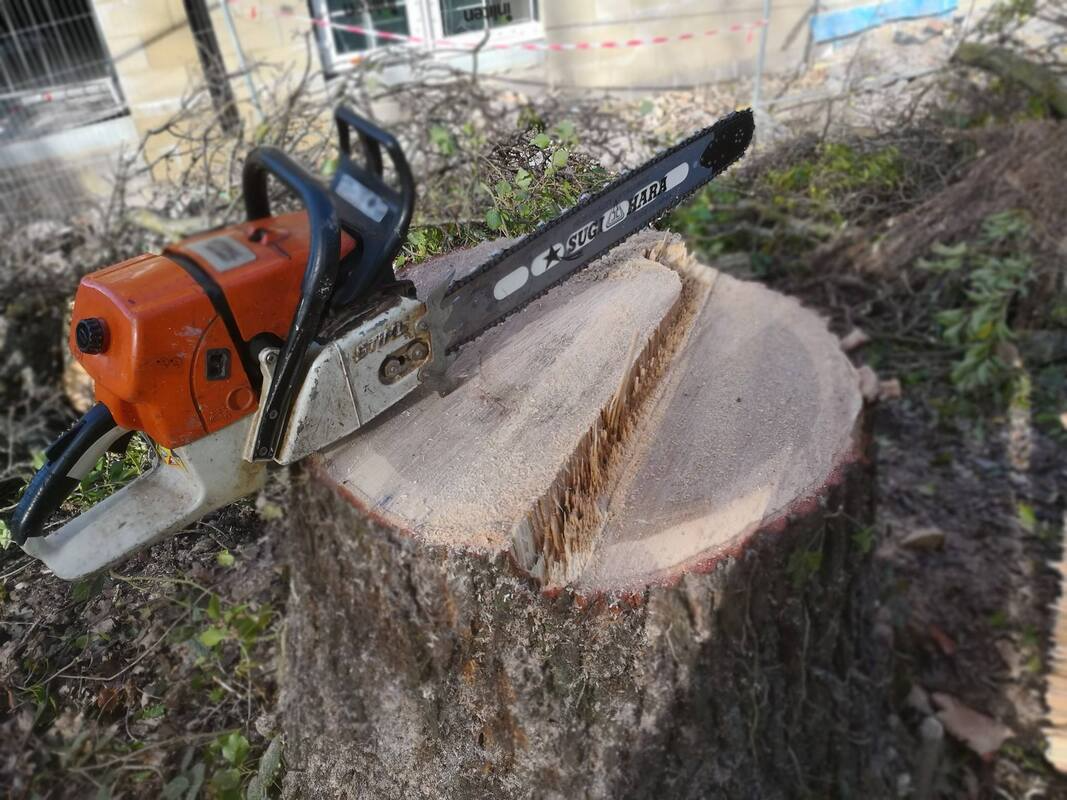
How to get rid of tree stumps
It's the time of year when tree stumps are everywhere! We get plenty of questions from people with trees on their property. You might be wondering if you should remove a tree stump or just let it go. The answer is that you need to remove a tree stump, but not for the reason you think. Let's look at everything there is to know about removing a tree stump and how to do it so that your garden or land looks great again!
Tree Stump Removal Questions.
Everything You Need to Know. Do tree stumps need to be removed? Is it bad to leave a tree stump where it is? What happens if you don't remove a tree stump? Will a tree stump attract termites or other pests like ants, snails, slugs or rats? Can the roots of a fallen "dead" tree still grow new leaves from its trunk without having any effect on nearby plants that are growing well already even though they're next to the damaged part of the root system (or what's left)? How long will this process take for an oak, birch, maple or pine tree? all these questions answered and more!
The quick answer to those questions is that tree stumps need to be removed. It's not bad or even a little bit good for the environment, nature and finally you (whoever owns the property) if there are any old tree stumps left intact in your yard or garden. Removing them will reduce termite infestations as well as other pests like ants, snails, slugs or rats from nesting under it too because they're purely attracted to the moist dirt and rotten wood part of what remains after cutting down an entire tree. Lastly without removing that stump out of sight where no one can see it anymore then the roots of fallen "dead" trees may grow new leaves but this doesn't mean anything really, it just slows down the process of decomposition.
Can a tree stump still grow:
it is unlikely that you will see any new shoots or growth from old stumps; many people think that roots are quite shallow and break off easily but this isn't always the case! Tree roots may extend as much as 30 feet away from the base of an oak tree for example. The average depth of root systems vary depending on soil type and location, however we do know that some species such as oaks, maples and birches have deep taproots which help them reach water sources. When should I remove my tree stump? If you're not planting any new trees, removing a tree stump can be done at your convenience.
How long will a tree stump live:
Tree stumps may last for two to three years before natural decomposition and soil erosion takes its toll on the old wood.
Can I still grow something on top of a tree stump that's already been removed?
You should ask your local landscape professional about this as they may know if there are any specific considerations when planting new trees in relation to existing stumps.
Can I still grow something on top of a tree stump that's already been removed?
You should ask your local
tree surgeon professional about this as they may know if there are any specific considerations when planting new trees in relation to existing stumps.""
How long does a tree live after its been cut down?
This can vary depending on how healthy and strong your particular tree was before being cut down. It could take anywhere from five years up to forty years.
What is a tree stump grinding machine and how do I use it?
To be honest, its not something i recommend in anyway shape or form, I have seen too many accidents and people hospitalised by going out and hiring stump grinding machines.
This type of equipment typically features diamond-tipped blades that are designed for cutting through tough materials like concrete, metal pipes, or tree stumps. A typical procedure starts with removing debris from around the area you want to grind; this will help prevent injury while using this heavy machinery from stopping it flying around the area. Barriers are also placed to limit the tree stump chipping's from hitting nearby structures or people for that matter. This tool has blades that spin around to chop up stumps into small pieces - they're great for getting rid of old roots, as without this method you will be having to do all this heavy hard labor yourself.
Stump removals
This term describes the process by which an entire tree's roots and trunk are extracted from the ground without damaging any nearby structures or harming living plants in close proximity to it. Some people mistakenly believe that stumps can't grow but this isn't true - they just won't grow as high because they're not getting enough water, sunlight, etc., so if you're still worried about one growing back up into your yard then we've got a solution for you: trees will actually remove themselves! They'll eventually die once their energy runs out and rot away over time. But don’t worry too much, as a tree will take at least five years to decompose and it will be much more difficult for a tree stump to grow again if you remove the root system that's keeping it alive.
Tree stumps attract termites but it's not the tree stump that causes a person to develop allergies. The small creatures, which are attracted by rotting wood and dried out plant matter in urban areas such as yards or parks, can enter human homes through cracks around windows and doors.
Removing a tree stump is not difficult, but it's important for homeowners and other property owners to know how long the process will take and what tools are needed before they start. For instance, hiring professionals may be more cost-effective than doing the work yourself with some of those methods that involve chemicals or dangerous equipment like chainsaws.
What causes stumps to rot?
Most experts agree that there's not much need for concern if a person removes them quickly and they're out in open space where air circulates freely. But when left unattended, rotting will set in as soon as damage occurs during removal, which allows water penetration down inside resulting in insect infestation. This could be avoided by using chemicals before cutting but this might lead to other environmental problems like septic leakage or wastewater pollution since some chemical treatments are not biodegradable.
What should you do if the stump is under a tree?
Leave it there until all of its roots are cut or pull out, otherwise they will grow back again and this process could take three to five years depending on how deeply rooted the tree was before being removed. The best way is to dig up gradually around where the root system spreads from so that when it's time for removal then one can just remove chunks of dirt along with any visible remaining roots. It's important to be patient because often times what takes place is that after cutting away a large section then people feel compelled by impatience to complete an extraction in as short amount of time as possible which causes them to make mistakes like breaking through underground pipes,
What are the different types of tree stumps?
Tree stumps can be any size, from a few inches high to more than two feet in height. The most common type is the softball sized roots that you see left behind after an old or diseased tree has been removed from your property and its root system dug out by a professional landscaper. These small bumps will eventually decompose over time as they rot away into nothingness without anything else being done at all! But if there's only one or two of these smaller trees on your property, wait about five years before taking care of them yourself - some people just let nature take its course when it comes to this matter while others prefer to get their tree stumps taken out straight away, as need to put the land back to use in other ways.
Tree suckers are the shoots that sprout from tree stumps. They can be cut down with a saw or an axe to prevent them from growing and becoming another tree stump themselves.
Diseases: The roots of old trees may have been diseased, which is why they needed removing in the first place! If you leave those same infected roots on your property, eventually it will transfer into other plants nearby - not just around the area where the original tree was removed but anywhere within about 50 feet as well. That means more work for you if you don't want these diseases spreading everywhere and ruining all your hard-earned landscaping efforts over time!
Conclusion: Once you have removed your tree stumps successfully there are also other steps that need to be done after they're gone! For example, if all of those roots weren't eliminated then new shoots may grow from them soon enough, this not what anyone wants when trying to beautify their property or lawn! Make sure you contact us today at Glasgow trees for more information about our stump removal services so we can help keep your trees looking healthy and strong while also staying safe as well, by removing any possible hazards beforehand.
Phone: 0141-483-7485
Get the professionals to do the job right first time!
Glasgow Trees, keeping it local.
Back to Home page

Contact Us


0141-483-7485
Glasgow Trees
Clyde Offices 2nd Floor
48 West George Street
Glasgow G2 1BP
Scotland, UK
Email: [email protected]
Copyright Glasgow Trees
What's Included When a Stump Is Ground or Dug Out
- A free site visit to look at the stump, species, and access before any work is booked or priced
- Grinding the stump and the visible surface roots down below the surrounding ground level using a stump grinder
- A full dig-out and root removal instead, where grinding isn't suitable for the site
- Machinery matched to the access -- from compact grinders for narrow side passages and backcourts up to an excavator for bigger root plates
- Chippings left in a pile for you to use as mulch, or cleared away, whichever you'd rather
- Advice on what can safely go over the ground once the work's done
Not Included / Costed Separately
- Reinstating the hole afterwards with topsoil, turf, or paving -- that's normally a separate job
- Digging out roots that have already spread under a patio, driveway, or drain, which can mean extra machinery time or careful hand work rather than a standard grind
- Grinding anywhere a machine physically can't reach -- some tight backcourt or side-access stumps have to be tackled by hand instead, which takes longer
- Any felling, hedge, or other tree work not agreed at the quote stage
How a Stump Job Runs, Start to Finish
- Initial enquiry -- You get in touch by phone or through the site and tell us how many stumps there are, roughly how big, and where access is -- front garden, back garden, or somewhere a vehicle can't reach directly.
- Free site visit -- We look at the stump itself, the species and root spread, and anything nearby that changes the job -- a drain, wall, shed, or overhead cable -- before giving a free, no-obligation quote.
- Method agreed -- Most stumps are ground out below ground level; larger ones, or those close to a structure, may be fully dug out instead, sometimes with an excavator if access allows.
- The grinding or digging -- The stump and surface roots are worked down below the surrounding soil so the area can be walked over, turfed, or planted, with the operator keeping clear of anything flagged at the site visit.
- Clear-up and handover -- Chippings are left as mulch or cleared, as agreed beforehand, and the area is left tidy before we go.
What Affects the Price of a Stump Job
Price comes down mainly to the stump's diameter, how deep and spread the roots are (a mature oak or beech root plate takes longer to grind than a young birch), how many stumps are involved, and whether the grinder can drive straight to the stump or has to be carried through a narrow gate or backcourt. A full dig-out with an excavator costs more than grinding on its own, simply because there's more ground disturbance and spoil to deal with. None of that can be priced accurately over the phone, which is why every quote starts with a free, no-obligation site visit rather than an estimate given blind.
Grinding, Digging Out, or Leaving It -- What Actually Makes Sense
| Option | What happens | Best suited to | Worth knowing |
|---|---|---|---|
| Stump grinding | A stump grinder cuts the stump and surface roots down below ground level | Most gardens where you want the area usable again fairly quickly | Deeper roots stay in the ground and break down naturally over the following years |
| Full removal (dig out) | The stump and root ball are dug out completely, sometimes with an excavator | Stumps close to drains, foundations, or where you're replanting straight away | More disturbance to the surrounding ground, and a larger area to reinstate afterwards |
| Leaving it to rot | No work carried out; the stump decays on its own over time | Only where there's no safety, access, or replanting pressure | Takes several years to break down fully, and can be a trip hazard or harbour pests meanwhile |
Trained on the Machinery, Not Just the Saw
Stump grinding is its own skill, separate from felling, and it's covered in our team's Lantra/NPTC machinery certification alongside the 360 excavator, wood chipper, and other plant used on larger jobs. Glasgow Trees has traded as Glasgow's tree surgery specialists since 2005, works to British Standard BS3998, and is fully insured -- and every quote is free and no-obligation, so you know what a job costs before anything is booked.
Where We Grind and Remove Stumps
Most stump work is in and around Glasgow itself, including tenement backcourts and tight side-access gardens where a compact grinder is needed, out to larger mature gardens in Bearsden, Newton Mearns, and Clarkston where older stumps tend to be bigger and more established. We also cover Renfrewshire and Paisley, Clydebank and Dumbarton in West Dunbartonshire, East Kilbride, Hamilton, and the wider Lanarkshire area, and out along the A82/M80 corridor towards Stirling, Kippen, and Bo'ness, where stumps are more often windblown conifers or larger rural trees rather than garden ornamentals. Full postcode coverage is on our [[LINK:https://www.glasgowtrees.co.uk/areas-we-cover.html|areas we cover]] page.

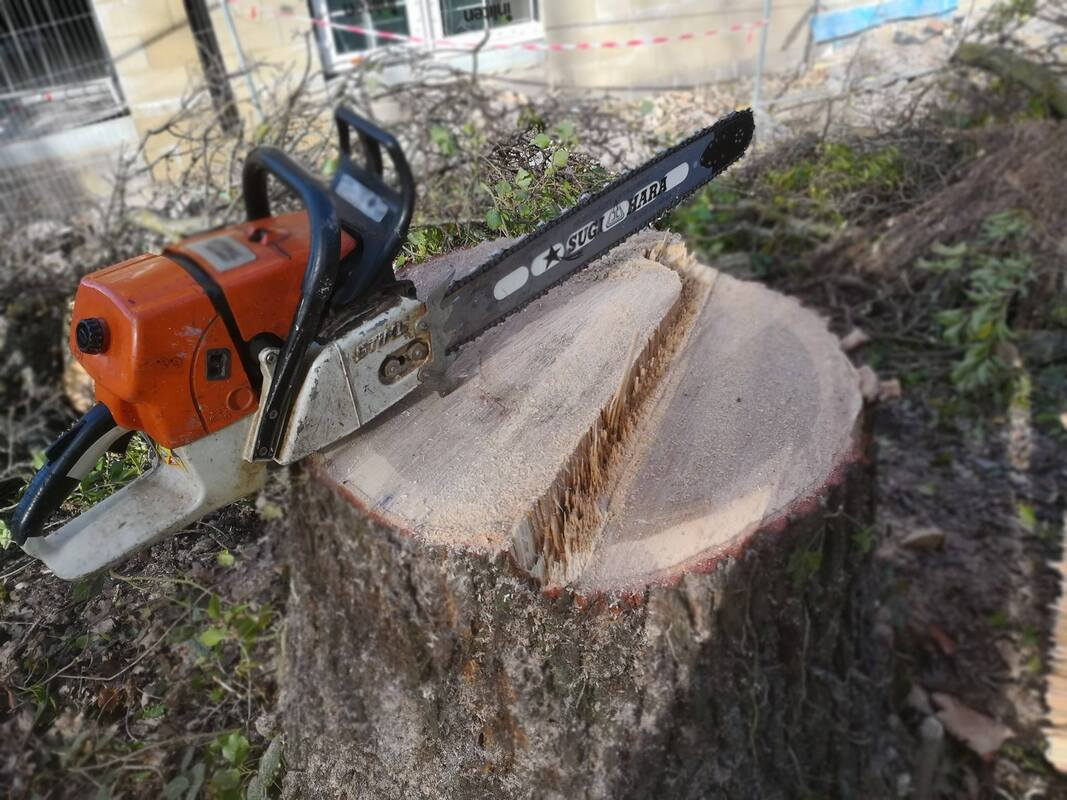

Stump Removal Questions We Get Asked
Do I actually need to remove a tree stump, or can I just leave it?
There's no rule that says you must. Plenty of stumps are left to rot down naturally over several years without causing any real harm. The usual reasons for having one ground out are wanting the ground back for lawn, planting, or a driveway sooner, or because it's become a trip hazard or is starting to attract fungal decay close to the house.
How long does grinding a stump actually take?
A single average-sized stump with reasonable access is usually done within an hour or two once the grinder's on site. Larger, multi-stemmed, or hardwood stumps, or ones needing the machine carried through a narrow access, take longer -- your site visit quote will give a realistic time rather than a guess.
What happens to the wood chippings afterwards?
That's up to you -- most people either keep them as mulch for beds and borders, or have them cleared away as part of the job. Worth mentioning which you'd prefer when you get your quote.
Will roots keep growing back after grinding?
Once the stump and surface roots are ground out, the root system left underground has no leaves to feed it, so it can't grow back into a tree. Some species will throw up suckers from any shallow roots left near the surface for a season or two, which is easily cut back if it happens.
Can a stump grinder be used near a wall, drain, or driveway?
It depends how close and how deep the roots have grown. Where there's a real risk to a drain, foundation, or buried service, we'll usually recommend a full dig-out instead, done more carefully and sometimes with an excavator, rather than grinding blind.
Is stump grinding noisy or messy?
It's a loud job while the machine's running, much like other groundworks machinery, and it does produce a fair amount of wood chip debris around the stump. We keep this contained as much as possible and it's cleared or piled up neatly by the time we leave, depending what's agreed.
Can you remove a large, old stump from a mature tree?
Yes -- bigger diameter stumps and larger root plates just take more time and, occasionally, a bigger grinder or an excavator rather than a small one. That's exactly what the site visit is for, so the quote reflects what's actually there rather than a size guessed over the phone.